It’s Sunny. It’s Summer

📚 Summer Reading: A Rebellion Worth Leading

It’s sunny. It’s summer. Which means kids everywhere are perfecting the fine art of screen time avoidance… unless, of course, the screen is a PlayStation.

All my grandkids are in town. It’s a joy. And yet, as I watch them, I can’t help but reflect on the world they’re growing up in—a world where attention is fractured, screens dominate, and reading often takes a backseat.

As school winds down and summer kicks in, we find ourselves staring at a truth we’ve known for years: when children stop reading, they start slipping.

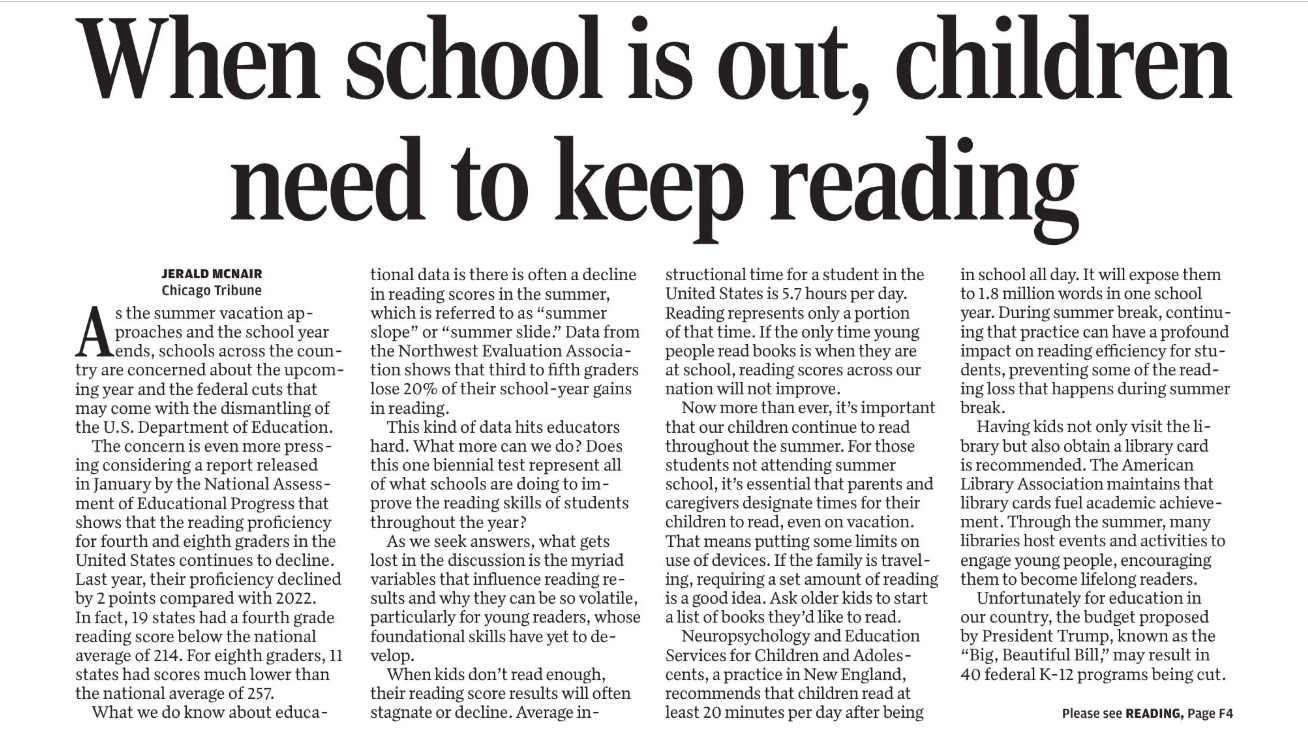
Jerald McNair’s recent op-ed in the Chicago Tribune—which appeared in today’s Buffalo News—delivers the data plainly. Reading scores for 4th and 8th graders continue to drop. “Summer slide”—the loss of reading progress over break—can erase 20% or more of what was learned. And once that momentum is gone, it’s rarely recovered. The Harvard Graduate School of Education even notes that after the first year of loss, little to no gain follows in the years that come.
So what do we do? We reframe reading as a cultural value, not just a school requirement.

I’ll be candid—I didn’t fall in love with reading until I was 34 years old. Better late than never. But once it clicked, it transformed how I viewed the world.

My friend Kevin Quinn, a lifelong reader with a degree in the classics, remembers his dad coming home from work in the 1970s and saying, “You’ve got two choices—go outside and play, or go read a book.” Growing up in Buffalo, Kevin chose books—especially when the cold kept him indoors.

For my own son, summer reading lists were the norm at his Jesuit high school. He’d spend most of the summer outside, living in the moment, but when August hit, he’d hunker down for a week of binge-reading to finish the list. It wasn’t always polished—but it built a muscle. And today, he still reads.

Now I see my grandkids—members of Generation Alpha—growing up fully immersed in digital devices. They’re bright, curious, and full of energy. But they need guidance to guard their attention spans. We try to encourage books alongside play, and we gently limit iPad time. It’s not about banning technology—it’s about giving reading a fighting chance to remain part of their rhythm.

And influence runs in both directions. My son now has the chance to shape the habits of his nephew—my 9-year-old grandson—who, like many kids his age, is a little too into PlayStation. Sometimes, the best messages don’t come from a parent—they come from an uncle, a cousin, or a grandparent. Maybe all it takes is a simple challenge: “Read for as long as you play.”

We could take a page from Malcolm Gladwell, who once wrote about how the American Cancer Society didn’t just raise awareness through commercials—they sparked a movement through community conversations. Hair salons were a key part of that success. Imagine if we took that same approach to reading. One real conversation. One bedtime story. One Kindle subscription. One nudge from a family member. It might just be enough.

If you’re still wondering why this matters, I point you to Garfinkle’s powerful whitepaper, The Erosion of Deep Literacy. It’s not just that fewer people read—it’s that we’re losing the ability to think deeply, empathize meaningfully, and analyze critically.

In a world addicted to quick takes and TikTok loops, reading remains our most underrated rebellion.

So this summer, forget flashy campaigns. Just ask your kids—or your grandkids—what they’re reading. And if they’re not, you’ve got a few choices: hand them a ball, set limits on PlayStation, or better yet—set a goal: read for as long as you play.
Human Connection Making a Comeback

Featured

What’s most enjoyable about life is that, on a daily basis, there are opportunities to meet new people. Human connection is at the heart of what makes life meaningful.

Yet we now live in an era where artificial intelligence is advancing at a pace few could have predicted. Photos are enhanced, voicemails generated, emails auto-written—entire video chats can now be convincingly faked. You can’t always trust your eyes—or your ears. So what do we trust?

What we’ve always trusted: the power of real, human relationships.

People have spent entire careers building, protecting, and nurturing relationships. Traders, artisans, the Fuller Brush salesman, the Avon Lady, the milkman, the local catalog rep—they brought more than products. They brought presence, personality, and trust. Whether it was a vacuum cleaner demonstration in the living room, a catalog left at the kitchen table, or a familiar face behind a longtime Elmwood Avenue storefront, these interactions were built on familiarity and connection. That legacy of human interaction is back at center stage. The handshake still matters. A face-to-face still wins the room. A coffee chat, a raised eyebrow, an offhand comment—all of those tiny, unprogrammed moments build rapport in ways no machine can replicate.

AI might be getting better at sounding human. But it’s still not being human.

AI-generated content—especially video and audio—will soon be so realistic, we won’t be able to tell what’s real and what’s fake. We’re on the brink of a new era of false perception and digital deception. For those who remember, Milli Vanilli was the Grammy-winning duo exposed for lip-syncing the songs that made them famous. When the truth came out, their careers collapsed.

In that spirit, an old advertising slogan feels more relevant than ever: Is it live, or is it Memorex?

That question is now front and center. Is what you’re seeing real—or just programmed to feel real?

There’s no question that AI has its place. It can process data, sketch ideas, and help refine language. But a tool is not a substitute for the talent—or the truth—behind it. What makes writing powerful, and work meaningful, is the human experience at its core.

We’re just a few years removed from the pandemic, when the world retreated into screens and home offices. For many, loneliness, mental fatigue, and isolation left lasting scars. In this post-COVID era, something powerful is reemerging: a hunger for authentic, in-person connection.

It’s showing up in meetings, networking events, and even casual run-ins at the grocery store. People want to reconnect—not just via a screen, but face to face. They want to see your smile, shake your hand, hear your voice. As trust in digital reality fades, trust in real relationships grows stronger.

This shift is also reshaping the workplace. Not long ago, many believed remote everything was the future. But now? Companies are calling people back—not just for productivity, but for connection. Culture doesn’t live in Slack messages. Loyalty isn’t built on Zoom. On Zoom, you can wear a tie and gym shorts; in real life, you wear the whole suit. Mentorship doesn’t happen in emoji reactions. Human presence matters.

Young professionals—those just starting out—are learning that what you know is important, but who you know—and how you treat them—matters just as much. Every relationship opens a door. Every meaningful connection leads to more. And the beauty of that principle? It never goes out of style.

No robot will ever replicate the nuance of a first impression or the feeling of being seen. No one walks away from a great meeting saying, “Wow, that Zoom background really moved me.” But plenty walk away thinking, “That person just gets it.”

As we enter an age of digital doubt—where even voices and videos may be faked—something simple is becoming rare again: authenticity. Cybercrime is rising fast, and trust is being exploited in new ways. Don’t hit “send” on that wire transfer until you’re certain the voice, face, or email on the other end is who they say they are.

That’s why the relationship economy is entering a renaissance. People will increasingly place value on realness. They’ll hire for it. Vote with it. Partner because of it.

If you’re fortunate enough to have strong relationships in your life, tend to them. And if you’ve been hiding behind screens or texts, show up. Shake hands. Ask questions. Listen closely. Connect deeply.

And the next time a perfectly polished message or AI-generated voice crosses your screen, ask yourself:Is it live—or is it Memorex?
If it’s real, you’ll know.

Aristotle and a cathartic moment

This article from The Buffalo News recently caught my attention:

🔗 John Proctor Is the Villain delivers catharsis

It covers a new play, John Proctor Is the Villain, which reimagines Arthur Miller’s classic The Crucible through a modern lens. Set in a Georgia high school classroom, it follows a group of students as they read the play and wrestle with themes of justice, loyalty, and power through the filter of their own lives. The journalist, Michelle Goldberg, also references Aristotle’s idea of catharsis—that deep emotional release we experience through storytelling and tragedy.

That word—catharsis—hit home for me.

It brought me back to the first time I read Arthur Miller’s other masterpiece, Death of a Salesman. I was shaken by the quiet despair of Willy Loman, a man who couldn’t bounce back from life’s blows. And then I thought of my own father—who, unlike Willy, never let getting fired define him. He stayed proud. He stayed useful. He kept going.

That contrast between Miller’s tragic character and my father’s quiet resilience stirred something in me I couldn’t shake. It led me to write an article about it:

📎 Willy Loman’s Plight Is Common Among Many Today

Looking back now, I realize that moment was cathartic in the truest sense of the word. It was a chance to reflect—not just on literature, but on life.

As someone surrounded by strong women—four daughters, a daughter-in-law, and my 93-year-old mother who still gives me advice I actually listen to—I’ve come to appreciate how the stories we tell, and how we choose to interpret them, really do evolve with each generation.

Sometimes it takes a 70-year-old play and a Greek philosopher to remind us that.

To Be Candid

To Be Candid: The Art of Truth in Recruiting

When candidates know you’re not going to violate their trust—that you’re not out to sell them but to understand them—they open up. That’s when the real interview starts. It’s not about interrogation; it’s about listening with curiosity and intention.

After 41 years of interviewing people, I’ve developed a finely tuned ear—not just for what candidates say, but for how they say it. One phrase that always catches my attention is: “To be honest with you…”

When I hear that, my internal response—often said with a grin—is, “So, have you not been honest up to now?”

Over the years, I’ve used that moment to coach candidates. Instead of saying “to be honest,” I encourage them to say, “Let me be candid with you.” It’s more direct, less loaded, and doesn’t carry the unintended implication that dishonesty might be the norm.

Recruiting, at its best, is a business of trust. There’s a kind of “Code of the West” among great recruiters—where a handshake still means something, and confidentiality is sacred. You can’t build a reputation if people don’t believe their words are safe with you.

Great recruiters are great listeners. They know that trust isn’t built by talking, but by truly hearing someone’s story without interruption, judgment, or the need to “one-up” them. When a candidate shares a personal or professional experience—especially one that’s vulnerable or hard-won—the worst thing you can do is respond with a story of your own. That moment isn’t about you. I’ve always believed the best teaching tool in this business is the reminder: “You’ve got one mouth and two ears—use them in proportion.” The best interviews happen when you let silence do some of the work and allow the candidate to fill in the gaps. Listening is where the magic is.

And let’s not forget—when it’s story time, a good embellishment is often just the seasoning that gives a tale its flavor. The kind of story that sticks, that gets retold, that has a life of its own. This typically happens after the formal interview ends—during the meeting after the meeting—when you’re no longer just a recruiter and they’re no longer just a candidate. You’re more than a friend, less than a stranger. That space—built on trust, a laugh, and maybe a slightly exaggerated anecdote—is where real relationships are born. And it’s that power of relationships that’s held me in good stead since my days as a paperboy right up through today.

Yes, people fib. They exaggerate roles, downplay gaps, and sometimes float self-flattering stories. But part of the job is knowing how to spot the spin—and more importantly—how to steer the conversation toward truth without making someone feel exposed.

There’s an art to asking questions, just as there’s a science to pattern recognition. Over time, you realize that honesty isn’t just about what’s said—it’s about what’s earned. When people feel safe, they get real. And in a world of “to be honest,” finding the candid is gold.


Even legends open up after the interview ends

Author’s Note:
A recent Buffalo News article by Bob O’Connor, titled “At least people are honest about how often they lie”, sparked this reflection. Bob shares personal stories and historical truths about the culture of lying, with humor and insight that’s well worth the read. His article reminded me of a phrase a former friend once shared with me: “If his lips are moving, he’s lying.” That line stuck. Over time, I’ve adapted it into my own go-to word—candid—because it feels fresh and sincere. And in recruiting, as in life, being candid builds the kind of trust that keeps relationships thriving.