Your Best Years are Ahead of You

By Joe Kreuz

Not long ago, I read an article titled “Your Professional Decline Is Coming (Much) Sooner Than You Think.” The image that accompanied it was striking: a man standing at the top of a staircase marked with ages—30, 40, 50—before the inevitable steps downward into 60 and 70. The message was clear: enjoy your peak, because what follows is decline.

At my age, I couldn’t disagree more.

It got me thinking of two friends—one in the nonprofit world and the other in business. One founded a nonprofit that hasn’t even hit its stride nationally. The other, in his seventies, hasn’t fully handed over the reins to his Gen X son, and for good reason—his wisdom remains indispensable. Or consider the many professionals I know in their 50s and 60s, all thriving in new roles. For them, this stage of life feels less like a decline and more like a beginning. As Winston Churchill once said:

“Now this is not the end. It is not even the beginning of the end. But it is, perhaps, the end of the beginning.”

Ironically, my very first Buffalo News “My View” piece was about Arthur Miller’s Death of a Salesman. Miller’s tragic character Willy Loman embodies what happens when someone believes their worth has an expiration date. He is consumed by the fear of being forgotten, convinced that once his best-selling years are behind him, his life no longer has meaning.

I think often of my own parents as the opposite example. My dad lived to age 90, and my mom—now 94—has avoided the thralls of a nursing home thanks to strong health and determination. Many of us Boomers are doing our best to stay active and engaged, defying the script that says we fade into irrelevance.

Willy Loman’s plight was a cautionary tale for Miller’s generation. But for ours, it’s an outdated narrative. I know countless men and women whose wisdom, networks, and steady judgment make them more valuable to their organizations—and to society—than ever before.

The truth is, age brings a unique currency: experience. AI may be changing everything, but companies still crave leaders who can connect dots quickly, draw from decades of problem-solving, and steady the ship when storms hit. You don’t learn that in business school, and you don’t always pick it up in your 20s or 30s.

A friend of mine recently hired a Boomer and told me, “This is exactly what we needed. Someone who’s seen the movie before.” That doesn’t sound like decline. That sounds like irreplaceable value.

Another myth is that by 50 or 60, people are winding down. In reality, many are winding up. I’ve watched friends reinvent themselves—taking on new ventures, joining boards, even starting companies. Some leave behind jobs that drained them, stepping into roles that finally align with their purpose.

Interestingly, the Wall Street Journal recently ran a piece by Suzy Welch asking, “Is Gen Z Unemployable?” She argued that hiring managers prize achievement and learning, while today’s youth prize pleasure and individuality.

But here’s the irony: older professionals are often dismissed for being “too set in their ways,” while younger ones are written off as “too self-focused.” Both narratives miss the point. What makes any generation employable isn’t their age—it’s their adaptability, drive, and willingness to keep learning.

My kids often serve as my focus group. They’ve helped me see that Gen Z values aren’t a threat to the workplace—they’re a recalibration. And in many ways, those values pair perfectly with the wisdom of older generations who’ve weathered decades of change.

We should retire the staircase metaphor with its grim march upward and inevitable stumble down. A better metaphor might be a series of plateaus, each offering a broader view as we climb higher. Or perhaps a bridge, stretching out further than we imagined, built on the foundation of the years that came before.

Willy Loman’s story ends in despair because he saw no worth in himself beyond his peak years. But life offers us another ending. At 50, 60, or 70, your value doesn’t vanish. It compounds.

So to that headline—“Your professional decline is coming sooner than you think.”

I would counter with this:

Your professional renaissance is closer than you realize.
Built to Last

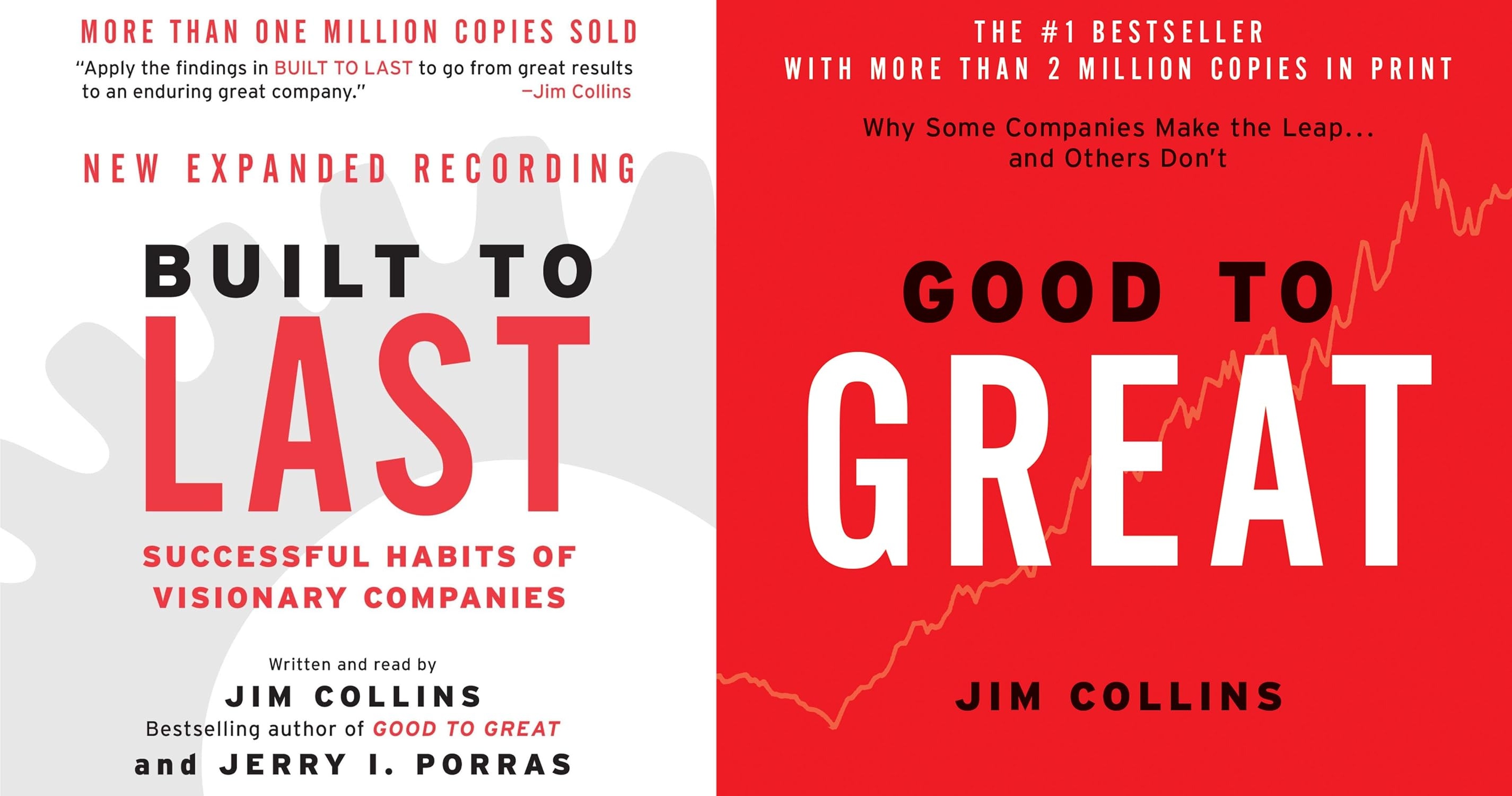
When I get the call to head a leadership transition, particularly at the C-suite level, I don’t arrive assuming the answer. I arrive with curiosity — and two books under my arm: Built to Last and Good to Great. I don’t cite them; I carry them as reminders. Reminders that leadership decisions are legacy decisions. The person chosen will shape not only financial performance, but culture, identity, and the narrative of the organization’s future.

I recall sitting with Mark Hamister years ago. He was a diehard reader of both books and a believer in what they stood for. Mid-conversation, he stopped me and asked, “Did you read them both?”
“Of course I did.”
“Which one did Collins write first?”
Built to Last.

I passed the test. He nodded — and we both agreed that the two books, in many ways, contradict each other. Built to Last celebrates internal continuity. Good to Great argues that companies become exceptional by bringing in Level 5 leadership — often from the outside. The truth is, both are right. And neither is right all the time. Mark hired from the outside — and that leader guided the company successfully for fourteen years.

That is the decision every organization must face: Do we promote from within, or do we look outside?

Some leaders believe deeply in developing their own. Others are convinced that real change must come from beyond the walls. Both instincts can be wise. Both can be misguided. The mistake is treating the choice as automatic rather than deliberate.

In most searches, I begin with the internal #2 — the leader who has been there through the battles, who knows where the organization has been and where it stumbled, who carries the institutional narrative almost subconsciously. Their insight is rarely loud, but it is deep. I sit with them and say what is almost never said aloud: You are a real candidate. I am your advocate just as much as I am for anyone outside this building. You have not earned the job by tenure — but you have absolutely earned the right to be seriously considered. It changes posture. It restores dignity. And it creates space for truth.

I once met an internal #2, Mike Buffamonti, CFO of Dynabrade, who came into our first meeting with a binder — not as a performance prop, but as preparation. We scheduled two hours. We spoke for four and a half. He walked me through the organization’s history — not the glossy brochure version, but the truth: the hard decisions, the setbacks, the proud wins. And then, in the final hour, he stood and presented something he had crafted quietly and privately: Where We’ve Been. Where We Are. Where We Could Go. He didn’t speak from his department’s vantage point. He spoke from the balcony — at the altitude of the enterprise. He didn’t ask for the job. He demonstrated readiness for it. The board came to the same conclusion I did: the right leader was already in the building. And he beat out a formidable CEO from an iconic global company.

But readiness is not always immediately visible. Doris Kearns Goodwin tells a remarkable story in Team of Rivals. When Abraham Lincoln was nominated for president in 1860, the New York Herald mocked the choice:

“The conduct of the republican party in this nomination is a remarkable indication of small intellect, growing smaller. They pass over… statesmen and able men, and they take up a fourth rate lecturer, who cannot speak good grammar.”
— The New York Herald, May 19, 1860

Lincoln did not come from pedigree or polish. But he carried clarity of purpose and moral steadiness. The world often underestimates the leaders it most needs.

There are also moments when no internal successor exists, and the organization needs a different voice. I once ran a national search where the final two candidates were so evenly matched you could have flipped a coin. Both were capable. Both were respected. Both would have succeeded. What broke the tie were the references — specifically, how each candidate’s past actions aligned with the company’s long-term strategy and shareholder direction. The candidate who ultimately won didn’t win because they were “better.” They won because their lived experience fit the organization’s future. That choice strengthened shareholder value and accelerated performance.

And then there are transitions where value cannot be measured on a spreadsheet. OLV Human Services reached such a crossroads. The scoreboard wasn’t margin, growth, or earnings. It was human outcomes. Lives. Families. The internal leader, Cindy Lee, didn’t lobby for the job — she simply lived the mission. She understood her community. She carried the culture. The right answer was clear not because she “deserved it,” but because she embodied it. Promoting from within was the only choice that honored the soul of the organization.

Different organizations measure value differently.
Shareholders measure return.
Leaders measure momentum.
Communities measure trust.
Nonprofits measure human impact.

Leadership is not decided by loyalty alone or innovation alone. It is decided by fit, readiness, character, and alignment with the future.

There are different ways to measure value. And it is not always about the bottom line.

Leadership is stewardship. And the right leader is the one who carries the story forward — steadily, responsibly, and with the wisdom to honor where the organization has been and where it is called to go next.

So whether it’s Built to Last or Good to Great, both have a seat at the table in the selection process.

Only in Hindsight

Only in Hindsight

This essay deserves its own chapter after my Volcker essay. It’s Black History Month, and my close friend Don Jones recently spoke in Tulsa to a convention crowd reflecting on moments that reshaped American history, including events from more than 100 years ago. He spoke about the 1921 Tulsa Race Massacre — the destruction of what had been known as “Black Wall Street,” where more than a thousand homes and businesses were burned and thousands were left homeless overnight. More than a century later, leaders like Don continue to return to this story not only for its relevance, but for the hard questions it raises about courage, responsibility, and civic virtue in today’s landscape. This essay, like others, only makes sense later.

For many Americans, Tulsa is a story discovered long after the fact — another reminder that history often hides in plain sight until a later generation is ready to confront it. Unlike economic crises measured in interest rates or unemployment, Tulsa represents a different kind of Black Swan — one that challenged the country’s moral foundation rather than its financial system.

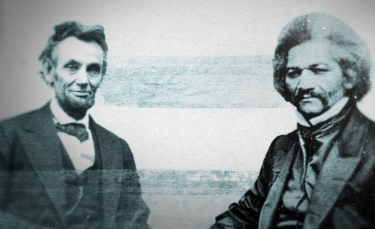
Talking to Don and understanding his reflections made me realize something: every era carries events that only reveal their full meaning decades later. Volcker’s fight against inflation reshaped the economy. COVID reshaped how we live and work. And Tulsa reminds us that history isn’t only about markets and policy — it’s about justice, memory, and the unfinished work of understanding who we are. Watching Don, an African American leader and admirer of Frederick Douglass, stand in Tulsa and name what happened on Black Wall Street, I realized I was seeing civic virtue in real time — the same kind of moral courage Douglass showed when he forced the nation to confront truths it wanted to ignore about slavery and freedom in his dealings with Abraham Lincoln and his cabinet during the Civil War era.

WWI had recently ended, and yet, after the shock of destruction and murder in Tulsa, just like after that brutal war, the country returned to work. Tulsa mourned. The nation kept going. Not because anyone fully understood what had happened, but because life demanded it.

Again, history repeats itself. It rhymes. Looking back across decades — Tulsa, Volcker’s inflation fight, COVID, the savings and loan crisis, the dot-com bust, 9/11, and the Great Recession — a pattern emerges. Every generation faces its own defining disruption. While we’re living through it, we rarely see the full picture. We feel the anxiety, the fear, the uncertainty. Meaning comes later.

Volcker’s story finally made sense to me not when interest rates were high, but when I had lived long enough to understand responsibility, restraint, and the cost of hard decisions. COVID may take years to fully understand as well. But it will shape a generation just as surely. The same holds true for “Black Wall Street.” Only in hindsight do we begin to see how these disruptions test not just our systems, but our souls. And if we are paying attention, they also reveal the quiet, stubborn virtue of people like Don, who choose to tell the truth anyway.

The real lesson isn’t economic. It’s human. Crises reveal character — in leaders, institutions, and ourselves. They remind us that stability is earned, resilience is learned, and understanding often arrives long after the moment has passed.

Every generation has its own Volcker, its own Tulsa, its own COVID — and, as Thoreau might argue, its own choice between quiet compliance and the hard work of conscience.

The question for all of us is simple: when the next Black Swan comes — and it will — what will we remember, and what will only make sense later?