PwC

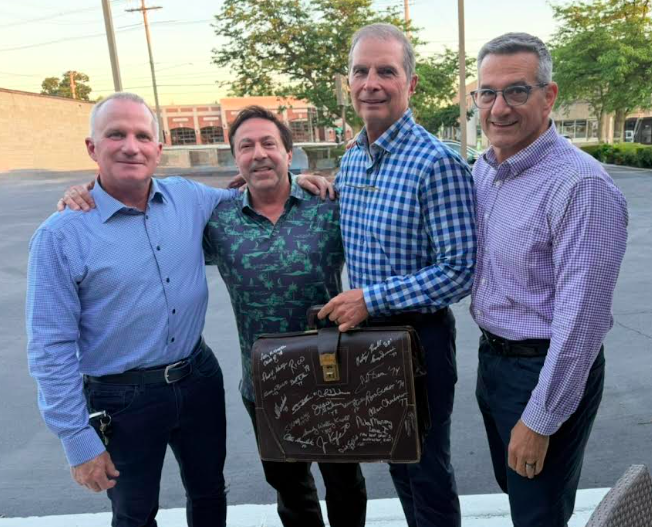
The Pen Club: Jim Segarra, Dave Hore, Rick Silvestri and Frank Muraca

The Legacy of the Bag: A Nod to Price Waterhouse, Then and Now

In the summer of 2024, at a makeshift PwC alumni golf outing, I was gifted something that instantly became one of my most prized professional possessions—a vintage Price Waterhouse audit bag, passed to me by Rico Wolney. He handed it over like a sacred relic, and without saying much, I knew exactly what it meant.

Later that year, at our annual Christmas luncheon, I brought the bag along with a silver Sharpie—and that’s when the story really took off. What began as a symbolic gesture has since taken on a life of its own.

This bag isn’t just a piece of worn leather with brass trim—it’s a living artifact from the days when Price Waterhouse stood tall among the original Big Eight accounting firms. For those keeping score, the full lineup was:

  • Price Waterhouse
  • Peat Marwick
  • Touche Ross
  • Deloitte
  • Arthur Andersen
  • Ernst & Ernst
  • Arthur Young
  • Coopers & Lybrand (there’s your eighth!)

Fast forward through decades of mergers and evolution, and we now refer to the Big Four: PwC, Deloitte, EY, and KPMG.

My personal connection to this world goes back to Gary Stott (PW ’72, Robert Half ’79), who recruited me to be his sidekick. But my journey really began in 1982 when Jerry Reynell hired me to sell payroll and tax services. Back then, everything revolved around referrals—and the best ones came from CPA firms, law firms, bankers, and insurance agents. We were trained to sell value-added services and, more importantly, to build lasting relationships.

This audit bag—now signed by numerous PwC alumni—is a physical symbol of that era. I brought the silver Sharpie again to the 2025 outing, and it didn’t take long before the bag became a tradition. Folks added their signatures, class years, and shared audit-room war stories over beers and laughter. We even joked it’s becoming the Stanley Cup of PwC alumni—and like the Cup, we may soon need to add another tier or commission a whole new tower to preserve the legacy.

They even made me an honorary member—kind of like getting one of those honorary PhDs from a university. And I’ll take it.

Here are both sides of the bag. Each signature represents more than just a name—it’s a career, a friendship, a referral, a golf outing, a deal, or maybe a late night poring over financial statements:

This post continues the theme from one of my earlier reflections on the power of groups, which was published in The Buffalo News. Whether it’s PwC or your neighborhood golf foursome, there’s something special about alumni communities that only grows stronger over time.

To those who’ve already signed the bag: thank you for your mentorship, your referrals, your stories—and your Sharpie ink.

And to those who haven’t signed it yet, there’s always this year’s lunch… or next year’s outing.

It’s Sunny. It’s Summer

📚 Summer Reading: A Rebellion Worth Leading

It’s sunny. It’s summer. Which means kids everywhere are perfecting the fine art of screen time avoidance… unless, of course, the screen is a PlayStation.

All my grandkids are in town. It’s a joy. And yet, as I watch them, I can’t help but reflect on the world they’re growing up in—a world where attention is fractured, screens dominate, and reading often takes a backseat.

As school winds down and summer kicks in, we find ourselves staring at a truth we’ve known for years: when children stop reading, they start slipping.

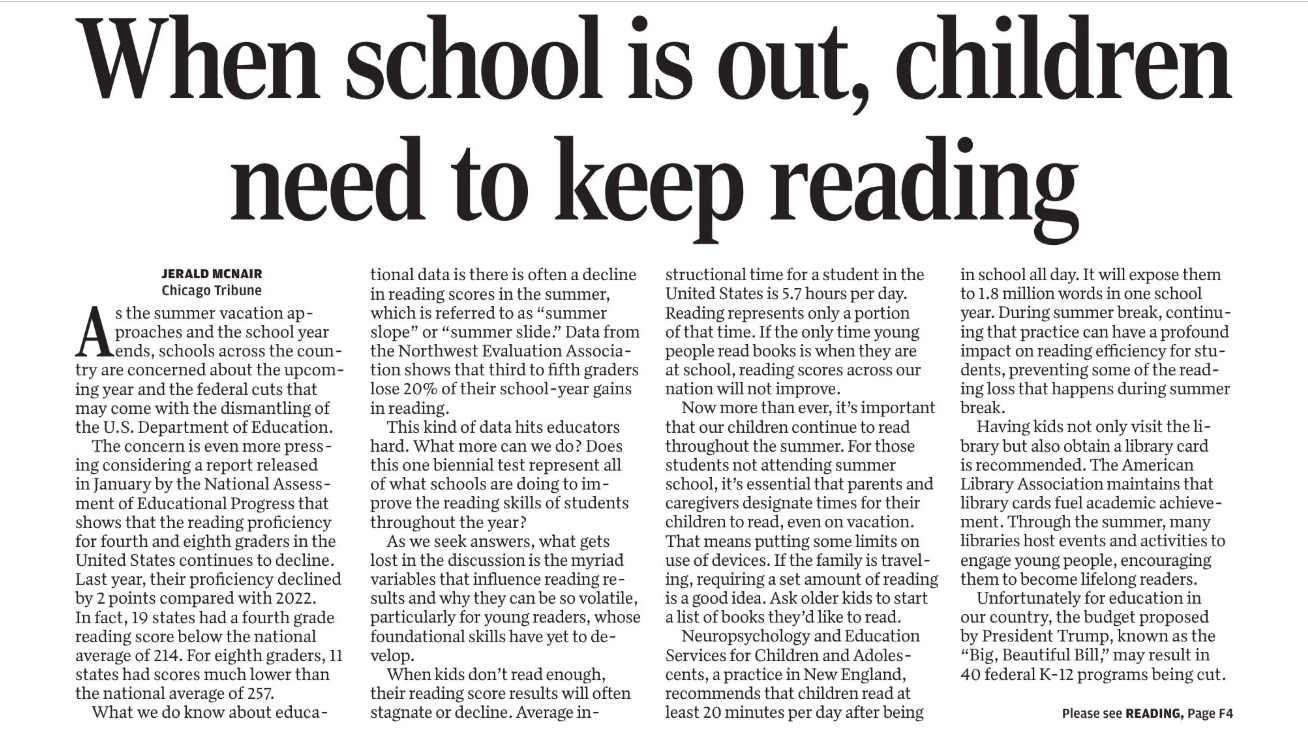
Jerald McNair’s recent op-ed in the Chicago Tribune—which appeared in today’s Buffalo News—delivers the data plainly. Reading scores for 4th and 8th graders continue to drop. “Summer slide”—the loss of reading progress over break—can erase 20% or more of what was learned. And once that momentum is gone, it’s rarely recovered. The Harvard Graduate School of Education even notes that after the first year of loss, little to no gain follows in the years that come.

So what do we do? We reframe reading as a cultural value, not just a school requirement.

I’ll be candid—I didn’t fall in love with reading until I was 34 years old. Better late than never. But once it clicked, it transformed how I viewed the world.

My friend Kevin Quinn, a lifelong reader with a degree in the classics, remembers his dad coming home from work in the 1970s and saying, “You’ve got two choices—go outside and play, or go read a book.” Growing up in Buffalo, Kevin chose books—especially when the cold kept him indoors.

For my own son, summer reading lists were the norm at his Jesuit high school. He’d spend most of the summer outside, living in the moment, but when August hit, he’d hunker down for a week of binge-reading to finish the list. It wasn’t always polished—but it built a muscle. And today, he still reads.

Now I see my grandkids—members of Generation Alpha—growing up fully immersed in digital devices. They’re bright, curious, and full of energy. But they need guidance to guard their attention spans. We try to encourage books alongside play, and we gently limit iPad time. It’s not about banning technology—it’s about giving reading a fighting chance to remain part of their rhythm.

And influence runs in both directions. My son now has the chance to shape the habits of his nephew—my 9-year-old grandson—who, like many kids his age, is a little too into PlayStation. Sometimes, the best messages don’t come from a parent—they come from an uncle, a cousin, or a grandparent. Maybe all it takes is a simple challenge: “Read for as long as you play.”

We could take a page from Malcolm Gladwell, who once wrote about how the American Cancer Society didn’t just raise awareness through commercials—they sparked a movement through community conversations. Hair salons were a key part of that success. Imagine if we took that same approach to reading. One real conversation. One bedtime story. One Kindle subscription. One nudge from a family member. It might just be enough.

If you’re still wondering why this matters, I point you to Garfinkle’s powerful whitepaper, The Erosion of Deep Literacy. It’s not just that fewer people read—it’s that we’re losing the ability to think deeply, empathize meaningfully, and analyze critically.

In a world addicted to quick takes and TikTok loops, reading remains our most underrated rebellion.

So this summer, forget flashy campaigns. Just ask your kids—or your grandkids—what they’re reading. And if they’re not, you’ve got a few choices: hand them a ball, set limits on PlayStation, or better yet—set a goal: read for as long as you play.

Human Connection Making a Comeback

Featured

What’s most enjoyable about life is that, on a daily basis, there are opportunities to meet new people. Human connection is at the heart of what makes life meaningful.

Yet we now live in an era where artificial intelligence is advancing at a pace few could have predicted. Photos are enhanced, voicemails generated, emails auto-written—entire video chats can now be convincingly faked. You can’t always trust your eyes—or your ears. So what do we trust?

What we’ve always trusted: the power of real, human relationships.

People have spent entire careers building, protecting, and nurturing relationships. Traders, artisans, the Fuller Brush salesman, the Avon Lady, the milkman, the local catalog rep—they brought more than products. They brought presence, personality, and trust. Whether it was a vacuum cleaner demonstration in the living room, a catalog left at the kitchen table, or a familiar face behind a longtime Elmwood Avenue storefront, these interactions were built on familiarity and connection. That legacy of human interaction is back at center stage. The handshake still matters. A face-to-face still wins the room. A coffee chat, a raised eyebrow, an offhand comment—all of those tiny, unprogrammed moments build rapport in ways no machine can replicate.

AI might be getting better at sounding human. But it’s still not being human.

AI-generated content—especially video and audio—will soon be so realistic, we won’t be able to tell what’s real and what’s fake. We’re on the brink of a new era of false perception and digital deception. For those who remember, Milli Vanilli was the Grammy-winning duo exposed for lip-syncing the songs that made them famous. When the truth came out, their careers collapsed.

In that spirit, an old advertising slogan feels more relevant than ever: Is it live, or is it Memorex?

That question is now front and center. Is what you’re seeing real—or just programmed to feel real?

There’s no question that AI has its place. It can process data, sketch ideas, and help refine language. But a tool is not a substitute for the talent—or the truth—behind it. What makes writing powerful, and work meaningful, is the human experience at its core.

We’re just a few years removed from the pandemic, when the world retreated into screens and home offices. For many, loneliness, mental fatigue, and isolation left lasting scars. In this post-COVID era, something powerful is reemerging: a hunger for authentic, in-person connection.

It’s showing up in meetings, networking events, and even casual run-ins at the grocery store. People want to reconnect—not just via a screen, but face to face. They want to see your smile, shake your hand, hear your voice. As trust in digital reality fades, trust in real relationships grows stronger.

This shift is also reshaping the workplace. Not long ago, many believed remote everything was the future. But now? Companies are calling people back—not just for productivity, but for connection. Culture doesn’t live in Slack messages. Loyalty isn’t built on Zoom. On Zoom, you can wear a tie and gym shorts; in real life, you wear the whole suit. Mentorship doesn’t happen in emoji reactions. Human presence matters.

Young professionals—those just starting out—are learning that what you know is important, but who you know—and how you treat them—matters just as much. Every relationship opens a door. Every meaningful connection leads to more. And the beauty of that principle? It never goes out of style.

No robot will ever replicate the nuance of a first impression or the feeling of being seen. No one walks away from a great meeting saying, “Wow, that Zoom background really moved me.” But plenty walk away thinking, “That person just gets it.”

As we enter an age of digital doubt—where even voices and videos may be faked—something simple is becoming rare again: authenticity. Cybercrime is rising fast, and trust is being exploited in new ways. Don’t hit “send” on that wire transfer until you’re certain the voice, face, or email on the other end is who they say they are.

That’s why the relationship economy is entering a renaissance. People will increasingly place value on realness. They’ll hire for it. Vote with it. Partner because of it.

If you’re fortunate enough to have strong relationships in your life, tend to them. And if you’ve been hiding behind screens or texts, show up. Shake hands. Ask questions. Listen closely. Connect deeply.

And the next time a perfectly polished message or AI-generated voice crosses your screen, ask yourself:Is it live—or is it Memorex?
If it’s real, you’ll know.

Aristotle and a cathartic moment

This article from The Buffalo News recently caught my attention:

🔗 John Proctor Is the Villain delivers catharsis

It covers a new play, John Proctor Is the Villain, which reimagines Arthur Miller’s classic The Crucible through a modern lens. Set in a Georgia high school classroom, it follows a group of students as they read the play and wrestle with themes of justice, loyalty, and power through the filter of their own lives. The journalist, Michelle Goldberg, also references Aristotle’s idea of catharsis—that deep emotional release we experience through storytelling and tragedy.

That word—catharsis—hit home for me.

It brought me back to the first time I read Arthur Miller’s other masterpiece, Death of a Salesman. I was shaken by the quiet despair of Willy Loman, a man who couldn’t bounce back from life’s blows. And then I thought of my own father—who, unlike Willy, never let getting fired define him. He stayed proud. He stayed useful. He kept going.

That contrast between Miller’s tragic character and my father’s quiet resilience stirred something in me I couldn’t shake. It led me to write an article about it:

📎 Willy Loman’s Plight Is Common Among Many Today

Looking back now, I realize that moment was cathartic in the truest sense of the word. It was a chance to reflect—not just on literature, but on life.

As someone surrounded by strong women—four daughters, a daughter-in-law, and my 93-year-old mother who still gives me advice I actually listen to—I’ve come to appreciate how the stories we tell, and how we choose to interpret them, really do evolve with each generation.

Sometimes it takes a 70-year-old play and a Greek philosopher to remind us that.

To Be Candid

To Be Candid: The Art of Truth in Recruiting

When candidates know you’re not going to violate their trust—that you’re not out to sell them but to understand them—they open up. That’s when the real interview starts. It’s not about interrogation; it’s about listening with curiosity and intention.

After 41 years of interviewing people, I’ve developed a finely tuned ear—not just for what candidates say, but for how they say it. One phrase that always catches my attention is: “To be honest with you…”

When I hear that, my internal response—often said with a grin—is, “So, have you not been honest up to now?”

Over the years, I’ve used that moment to coach candidates. Instead of saying “to be honest,” I encourage them to say, “Let me be candid with you.” It’s more direct, less loaded, and doesn’t carry the unintended implication that dishonesty might be the norm.

Recruiting, at its best, is a business of trust. There’s a kind of “Code of the West” among great recruiters—where a handshake still means something, and confidentiality is sacred. You can’t build a reputation if people don’t believe their words are safe with you.

Great recruiters are great listeners. They know that trust isn’t built by talking, but by truly hearing someone’s story without interruption, judgment, or the need to “one-up” them. When a candidate shares a personal or professional experience—especially one that’s vulnerable or hard-won—the worst thing you can do is respond with a story of your own. That moment isn’t about you. I’ve always believed the best teaching tool in this business is the reminder: “You’ve got one mouth and two ears—use them in proportion.” The best interviews happen when you let silence do some of the work and allow the candidate to fill in the gaps. Listening is where the magic is.

And let’s not forget—when it’s story time, a good embellishment is often just the seasoning that gives a tale its flavor. The kind of story that sticks, that gets retold, that has a life of its own. This typically happens after the formal interview ends—during the meeting after the meeting—when you’re no longer just a recruiter and they’re no longer just a candidate. You’re more than a friend, less than a stranger. That space—built on trust, a laugh, and maybe a slightly exaggerated anecdote—is where real relationships are born. And it’s that power of relationships that’s held me in good stead since my days as a paperboy right up through today.

Yes, people fib. They exaggerate roles, downplay gaps, and sometimes float self-flattering stories. But part of the job is knowing how to spot the spin—and more importantly—how to steer the conversation toward truth without making someone feel exposed.

There’s an art to asking questions, just as there’s a science to pattern recognition. Over time, you realize that honesty isn’t just about what’s said—it’s about what’s earned. When people feel safe, they get real. And in a world of “to be honest,” finding the candid is gold.


Even legends open up after the interview ends

Author’s Note:
A recent Buffalo News article by Bob O’Connor, titled “At least people are honest about how often they lie”, sparked this reflection. Bob shares personal stories and historical truths about the culture of lying, with humor and insight that’s well worth the read. His article reminded me of a phrase a former friend once shared with me: “If his lips are moving, he’s lying.” That line stuck. Over time, I’ve adapted it into my own go-to word—candid—because it feels fresh and sincere. And in recruiting, as in life, being candid builds the kind of trust that keeps relationships thriving.

The Power of Groups

What’s a group, you ask? Think of it as the ecosystem of your life—personal friend circles, professional associations, golf groups, happy hour huddles, clubs, boards, book clubs, and yes, those endless group chats where 90% of the content is memes, and the other 10% is someone asking, “What’s the plan?”

If only Android and iPhone would let you name these text groups, right? It’s a tragedy on par with daylight savings time, which is still confusing clocks and calendars everywhere. But let’s not dwell on tech shortcomings—this is about celebrating the joy of connection, the lessons we learn from each other, and the sometimes ridiculous (but always memorable) dynamics that emerge when people come together. Groups can also play a vital role in mental health, providing support, therapy, and a sense of belonging.

This post isn’t just about my groups—it’s about your groups too. It’s about celebrating the joy of connection, the lessons we learn from each other, and the sometimes ridiculous (but always memorable) dynamics that emerge when people come together. My inspiration? Pamela Say, author of Waking Up Grateful. Pam introduced me to the Social Change Model for Leadership Development she discovered while on walkabout at a UCLA think tank, an idea that sparked memories of all the groups that have shaped my journey.

Let me warn you: this isn’t just a nostalgic walk down memory lane. By the end, you’ll probably find yourself reflecting on your own groups—those you cherish, those you’ve left behind, and maybe those you’re overdue to reconnect with. Consider this your group therapy session, with a side of wit and wisdom.

Chapter one of AP Professionals and enduring get togethers

Key Takeaways from That UCLA Think Tank

Pam’s insights on the Social Change Model of Leadership Development offered two enduring lessons:

  • Shared Purpose Drives Connection: Groups thrive when members align under a common goal while embracing each other’s unique strengths and values.
  • Growth Sometimes Means Letting Go: Recognizing when it’s time to move on is as important as joining. Some groups, like relationships, naturally run their course.

These ideas became a lens for revisiting the countless groups I’ve been part of—from little league football to professional networks. Each one taught me about relationships, resilience, and the importance of boundaries.

Groups that forged my earliest bonds and taught me the value of collaboration and camaraderie.

Foundations of Friendship and Teamwork
“From the field and the fairways to the future—where teamwork never ends.”

My journey began with my 7th and 8th grade little league football team, the “Marines.” Formed in 1971, this group instilled shared values of teamwork and friendship. Decades later, a vintage team photo and a lively group text keep those memories alive. It was my first experience with a group united by a shared purpose—learning football, winning championships, and fostering camaraderie.

Our team was guided by four eclectic coaches, each playing a meaningful role. Among them was Orkie Brown, our fitness coach, who ran the daylights out of us before and after practice. In those pre-Gatorade and water bottle days, we stood in line at the drinking fountain and water hose, further cementing our bond. We won a few championships, and I’ll admit to embellishing a story or two about our dominance over the years.

The Marines 1972

Fast forward to high school, and the Williamsville South High School Golf Team and University of Buffalo Golf team became another source of enduring friendships. Three years undefeated, three friends for life—our team wasn’t just about birdies and eagles but about building bonds that have stood the test of time. Whether on the course or in life, Rich Weber, John Gaffney, and I remain connected, even standing in each other’s weddings. Decades later, we’re still enjoying the links together, reliving the glory days with every round.

Professional Circles

Groups that shaped my career, offered mentorship, and inspired professional growth.

PriceWaterhouseCoopers (PwC) Alumni and the Pen Club
“From the past to the present—connecting legacies, one swanky pen at a time.”

I owe my connection to the PwC alumni group to my mentor, Gary Stott, who introduced me to this circle of friends he had worked with out of college. Over the years, this group has remained a constant source of camaraderie and professional insight. At the 2024 PwC alumni golf outing, I was honored to be made an official honorary member—a testament to the enduring bonds formed through shared experiences.

The Pen Club, a subset of this alumni network, emerged during a dinner where I handed out some of my swanky company pens. The name stuck, and the group became its own unique gathering, rooted in shared values and lighthearted traditions. Whether on the golf course or around the dinner table, these groups continue to be a meaningful part of my professional and personal life.

And the Ernst and Young group dubbed the Caddyshack group offers further banter and story after story. Just stay away from the Zin.

The Pen Club get togethers never disappoint

Intellectual Exploration and Deep Conversations
“Exploring ideas, igniting intellect, and dancing through life’s lessons.”

Intellectual groups have been a cornerstone of my personal growth, offering spaces for both philosophical debates and spiritual reflection. The Atlas Shrugged Society, inspired by my passion for Ayn Rand’s work, became a hub for deep intellectual exploration. Under the guidance of Alan Weisstein, PhD, as our Head of Wisdom and Intellect, the group challenges perspectives and fosters curiosity. Special thanks go to those who helped bring this group to life, making it a vibrant forum for thought and discussion.

Similarly, The Downtown Priest Committee, led by Father John G. Sturm SJ, added a spiritual dimension to intellectual engagement. Originating during my son’s time at Canisius High School, this group delved into Father Sturm’s teachings, often drawing on his book Life’s a Dance, Not a Dress Rehearsal. Together, these groups illustrate the value of ideas and the transformative power of shared learning.

Mentorship and Legacy Building

The Buffalo Renaissance Foundation: “Creating change, one charitable act at a time.”

This fraternal group, founded in the early 80s, has long been dedicated to raising and donating funds for charitable causes. I was fortunate enough to be invited in the mid-90s, and over 25 years later, I’ve had the privilege of witnessing its evolution into a multi-generational circle of philanthropy. Today, we’re a mix of Baby Boomers, Gen Xers, and Millennials, all working together to keep the faith, spirit, and mission alive—sometimes even agreeing on the same golf foursomes.

The group now boasts 70 members strong, with older members stepping back as “sustainers” to make way for fresh faces and new energy. Of course, the sustainers still have their say—they’ve earned it—and their stories often rival the length of our annual meetings. Our flagship events—the annual CEO awards luncheon and golf outing—are a blend of networking, inspiration, and the occasional good-natured debate about whose backswing needs the most work.

One especially memorable moment came during our tours of the Buffalo Bills and UB Bulls football operations. Members couldn’t resist hopping up to the podiums, striking poses in the locker rooms, and trying out the weight rooms—reliving their own glory days for a few unforgettable snapshots. It was a perfect example of the camaraderie and humor that define our group, even as we tackle serious charitable initiatives.

Whether it’s celebrating local leaders, teeing off for a good cause, or simply catching up over a round of drinks, The Buffalo Renaissance Foundation is more than a group—it’s a tradition.

The annual Buffalo Renaissance general meeting never disappoints

Shared Interests and Lighthearted Joy

Sam’s Club: “Healthcare meets humor—where insights flow, and relationships grow.”

This eclectic group of healthcare executives—CEOs, lawyers, physicians, PhDs, HR professionals, a judge, and administrators—thrives on blending lighthearted banter with deep professional insights. Think of it as part boardroom strategy session, part stand-up comedy show, where no topic is off-limits, and no punchline goes unappreciated.

At the helm is Mike Moley, wielding the club’s metaphorical gavel with a perfect mix of humor and wisdom, keeping our schedule—and occasionally our egos—in check. Whether we’re dissecting payer and provider networks or debating the best lunch spots (and whose turn it is to pay), Sam’s Club proves that even in serious industries, a good laugh can spark innovation and foster meaningful connections.

The Sam’s Club annual black tie gathering is always a festive setting approving new members

6

Former Colleagues, Forever Friends

The Little Rascals: “Building a business, creating bonds—one late night at a time.”

This group, made up of my original employees from AP Professionals, became much more than colleagues; they became family. Sheila O’Brien, my very first hire, was the glue that held us together in those early days. Together, we navigated the late nights, tight deadlines, and the countless “what-if” moments that come with building a business from the ground up.

Our journey didn’t end when the workday was over. Over the years, we’ve celebrated weddings, welcomed new additions to our families, and stood shoulder to shoulder at funerals, sharing both joy and grief. The bonds we built in the office evolved into something far deeper—an enduring connection that has lasted more than three decades.

Even as our professional paths shifted, the humor that got us through those hectic 90s remained a constant. From trading stories of our “war room” moments to reminiscing about those late-night brainstorming sessions fueled by coffee (and sometimes sheer panic), we’ve always found a way to laugh together.

Today, we gather less frequently and often enough with the same energy and appreciation. Whether it’s a birthday celebration or just catching up over dinner, the value of this group remains undeniable. The Little Rascals didn’t just help build a business—they helped shape a lifetime of memories and friendships.

Weaving Leadership, Purpose, and Values
In many groups, my contributions have ranged from providing leadership and sharing insights gained over 30+ years of building a business to offering subtle value through storytelling, humor, and wisdom. Regardless of the nature of these contributions, the relationships I’ve formed have been deeply enriching and enduring. While some groups align effortlessly, others require effort to foster connection, but the value of these relationships always endures. There’s always a subject matter expert just a phone call away.

Purpose, Values, and the Future of Groups
Reflecting on my journey, I realize how each group has added depth to my understanding of leadership and community. These experiences have shaped my worldview, layering lessons of resilience and collaboration. Looking ahead, I’m excited to continue forming and contributing to groups that balance shared and individual values, always building relationships that stand the test of time.

The Groups I Left
Not all groups are meant to last forever. As values shift or dynamics change, stepping away can become the right decision for growth. These departures, however, have often been marked by mutual respect and understanding. Even when moving on, the friendships and connections often remain. Sometimes, alignment fades, and stepping away becomes necessary for everyone’s benefit. Each departure has reminded me of the importance of maintaining boundaries while seeking opportunities better aligned with evolving values.

Closing Thought
As Pam Say’s book reminds us, gratitude is a powerful force. I’m thankful for every group, every lesson, and every shared purpose. To all those I’ve met along the way: don’t worry, you haven’t heard the last of me. There’s usually a good reason to light the fuse and reignite any group at any time—though some may need a little more coaxing (and maybe a few drinks) to get back into full swing.
To my groups I haven’t heard from in a while, consider this your call to action. After all, what’s a reunion without a few embellished stories and exaggerated accomplishments? Call me when you’re ready for the encore! Whether it’s rekindling an old group or forming a new one, every great story deserves a sequel.

Christmas Cards

Mission accomplished: the Christmas cards are out! It’s no small feat—more like a marathon of creativity, logistics, and perseverance. First, there’s the final design, the anticipation of delivery from the publisher and the battle of the address list. I stay in my lane; the design is not in my job description—and never will be. Correcting addresses for the umpteenth time has become a holiday tradition in itself. List management is crucial: adding new friends, loved ones gone, and having that awkward “should we really still send them one?” moment.

Eloise might just make the Christmas card next year

And then, there’s the question: why do we send cards to old bosses or people we might not even like anymore? But isn’t that part of the season’s magic? The spirit of Christmas nudges us to rekindle connections, soften the edges of strained friendships, and perhaps even surprise someone who thought they were forgotten.

Next comes the production line: return address—front or back? Choosing the perfect Christmas stamp (adhesive or licked?). And wow, when did stamps get so expensive? Stuffing the envelopes with precision. And let’s not forget the dreaded envelope licking. Sorry, but those water contraptions? Useless. They warp the cards and steal the joy. Yes, licking is unpleasant, but tradition demands sacrifices. Paper cuts? They’re part of the journey.

And let’s call them what they are: Christmas cards. This widely celebrated holiday transcends borders and beliefs. It’s a shared tradition, a universal gesture of connection.

The silver lining of this annual ritual is reconnecting with friends and reflecting on those we’ve lost. Updating the list becomes a bittersweet exercise: deciding to keep one family member while leaving out another, or pausing to honor the memory of a loved one who’s passed on.

For me, the true joy comes from sitting side by side with my wife, assembling our cards while thinking of all the people who have touched our lives. And then there’s the incoming stream of cards! They arrive in a delightful variety of styles: updated family photos, handwritten notes, humor, and heartfelt messages. Some feature collages, while others stick to one perfect picture.

The big question: does the boyfriend or girlfriend make it into the photo this year, or are they left out? And, of course, the excitement when a new family member makes their debut on a friend’s card—a baby, a pet, or sometimes even a spouse who wasn’t there last year.

The mother lode usually arrives on December 22nd, with a flurry of deliveries that bring the kitchen counter to life. Then comes my favorite tradition: the annual “Best Late Card” award. It’s December 27th and we’ve already received five really good ones. It’s for the friend whose card arrives fashionably late, often with the disclaimer, “This year, we’re finally on time!”

Once Christmas arrives, the cards take on a new life. Displayed on the refrigerator, kitchen cabinets, or a special mantle, they become part of the holiday decor. Every visit to someone’s home becomes an opportunity to scan their display. Inevitably, there’s the moment when you spot an absence: “Wait—why didn’t we get a card from them this year?!”

And one of my proudest moments? Seeing our family card make it to the mirror of fame at my barber’s shop. It’s like a badge of honor, knowing our card sits alongside others in a place where conversations flow and connections are celebrated.

For me, the Christmas card represents more than just the joy of the season—it’s about connection. It’s a tradition that reminds us to pause and appreciate the people in our lives, to share laughter and memories, and to celebrate the love that surrounds us.

Happy Christmas—and may your cards be on time (or at least arrive with a fashionable excuse)!

The 2024 card touches all the bases

Reading Makes You Interesting

I can still vividly recall the magic moment when I learned to read in the first grade. It was transformative—right up there with learning to swim or the thrill of riding a bike for the first time. It felt like unlocking a new world of possibilities. Yet, for much of my early years, reading didn’t take center stage. The only books I remember from grade school and high school were assignments like A Tale of Two Cities, which left little impression. To get by, I often relied on Monarch Notes. My early reading repertoire consisted mainly of sports biographies: For some reason the two I remember are a story about Bobby Chandler of the Buffalo Bills and another about Jerry Kramer’s Instant Replay: The Green Bay Diary of Jerry Kramer.” Co-written with sportswriter Dick Schaap, an account of his near-death experiences and life as a Green Bay Packer. Beyond those, reading didn’t play a significant role in my life—until my early thirties.

Everything Changed at Age 34
At 34, my perspective on reading shifted entirely. My business partner walked into my office with a eclectic stack of ten books as I navigated a one-year non-compete clause after leaving my job. With time to consider and grow, I turned to those books and found my world expanding. The first book I picked up was Harvey Mackay’s Swim with the Sharks Without Being Eaten Alive. I remember reading it during one of my daughter’s gymnastics meets, making notes on Mackay’s famed McKay 66 customer insights, and sharing them with my father, the consummate salesman.

My dad then showed me the book he read, The Sale Begins When the Customer Says No, published in November 1953. The copy he shared, filled with humor and practical wisdom, offered a fascinating look at the sales principles he embraced in his career. This classic predates Harvey Mackay’s work and made me wonder if Mackay had drawn inspiration from it. Seeing the connection between these works reinforced the timeless nature of great ideas and their ability to shape generations.

That stack of books became a gateway to a new mindset. Titles like Seven Habits of Highly Effective People, In Search of Excellence, Swoosh: The Story of Nike and the Men Who Played There, and Herman Hesse’s Siddhartha inspired me to think deeper and apply their lessons to my life. That year helped me develop a habit of reflective, deep reading—equating insights from books to real-life scenarios. It truly was a new experience and my new walkabout was afoot.

A New Era of Reading
Reading soon became a daily joy. Early mornings and airplane rides emerged as my favorite times to immerse myself in a book. A dozen or so friends of aspire to those peaceful, productive hours noted in my post on “The Early Risers Club.” I often reflect on how difficult it was to find quiet reading spaces during my high school years in a bustling household. Back then, the University at Buffalo Law Library became my haven for focused studying, even if it wasn’t traditional reading. Those moments honed my ability to concentrate and find value in written words.

Books That Stay, Books That Wait
As I scan the shelves in my home, office, and Kindle history, I reminisce about the eclectic mix. Some books are unforgettable—like Ayn Rand’s Atlas Shrugged, a favorite that shaped my philosophical outlook and inspired its own dedicated article. It’s the only book I’ve ever read twice. After finishing it, I devoured The Fountainhead and watched the classic Gary Cooper adaptation. James Bradley’s The Imperial Cruise, Flags of Our Fathers, and The China Mirage, as well as Lawrence Wright’s The Looming Tower, were equally compelling, providing deep insights into historical and cultural contexts.

I also polished off McCullough’s John Adams and Harry Truman. McCullough’s depth of storytelling about generations past made me feel like I’d just completed a master’s class in U.S. history and almost finished with McCullough’s book about the Brooklyn Bridge. For that, I highly recommend all three books.

Some books, yet, stay unfinished. Titan: The Life of John D. Rockefeller, Sr. has eluded completion for five years, despite its fascinating content. I would’ve finished King Rat but I was channel surfing and came across the older movie version and that spoiled the rest of the mystery. Others, like A Man Called Intrepid, came into my life with a story of their own. A business partner’s unexpected departure prompted a friend to say, “The ones who stay are the intrepid souls.” That statement resonated deeply, compelling me to pick up the book. Then there are books like Rebel Ride that sit patiently on my shelf, waiting for their moment. I’ve often heard excerpts about Stonewall Jackson and wondered how the Civil War have unfolded had he not died in action.

The Erosion of Deep Literacy
Adam Garfinkle’s article The Erosion of Deep Literacy helped me articulate the unique impact reading has on me. He defines deep literacy as the ability to engage with a text, anticipate the author’s direction, and connect it with personal knowledge to gain original insights. I often find myself doing just that—connecting characters and themes to real-life friends, colleagues, or situations. The article is worthy of a read for you deep thinkers so click here

Garfinkle also highlights how multitasking and screen use erode attention spans. While I occasionally pause my reading to research something sparked by a book, I’ve learned to embrace those moments as part of my curiosity-driven process. Still, I value the focused attention that deep reading requires, and I strive to cultivate it daily. My favorite digression is my Kindle’s access to a dictionary and Wikipedia.

Reading and Family
Garfinkle’s assertion that shared reading builds a foundation for literacy resonates with me deeply. Cindy and I always read to our kids. Green Eggs and Ham was so frequently read to Kelly that she memorized it. One night, when I skipped ten pages while half-asleep, she immediately called me out. Today, our youngest would rather read a book than watch TV—a testament to the impact of those early reading sessions.

My mother-in-law, Gisela, is another source of inspiration. A devout reader, she once told me, “A good book is a great companion.” Her thirst for literature reminds me of historical figures like John Adams and Thomas Jefferson, who clamored for knowledge. Gisela’s love for reading has enriched my own appreciation for books as companions in life’s journey. If one of my books goes missing, I usually know where to find it.

Why I Keep Reading
Books offer reflection, knowledge, and the joy of escaping into another world. Whether it’s Atlas Shrugged challenging my philosophy, Brooklyn Brifdge story on The Great Bridge drawing parallels between the Brooklyn Bridge and building a business, or Garfinkle’s insights about literacy, reading always teaches me something new. It’s a lens through which I understand the world and my place in it.

My library has also become a touchstone for connection. Office visitors often comment on the eclectic mix of books, sparking conversations that transcend the original context of their visit. It’s a reminder that books don’t just shape the individual—they also create opportunities for shared growth and understanding. I had the privilege of observing screenwriter Tom Fontana’s massive library, a collection I still talk about to this day.

Final Thoughts
Reading has been a lifelong journey of discovery, from the first-grade magic of learning to read to the transformative moment at 34 that changed everything. Books are more than words on a page; they’re threads that weave together knowledge, relationships, and personal growth. Each one carries a story—how it came into my life, how it influenced my thinking, or how it waits patiently for its turn. Through them, I’ve learned that every story, like every life, holds lessons worth discovering. There’s always room for a constant companion—that being a good book.

So, when you’re done with Jake from State Farm and his late-night, “What are you wearing, Jake?” commercials, and you’re still basking in the peaceful solitude of an early morning, why not pick up that book you’ve been meaning to finish? Who knows, it can just offer more wisdom than any ad for affordable insurance.

When You Need Me You Need Me

I’ve been circulating a cartoon for years highlighting the value of anyone paid a fee for services rendered. And just recently I read an article about an expert who fits the cartoon. Together, the cartoon and the article inspired these thoughts and this perspective. There are moments in every profession when clients realize, “When you need me, you need me.” It’s that simple. Sometimes, you need a specific solution, or things just go wrong. When they do, people look for that one person who brings years of experience, a steady hand, and the knowledge to make things right. I’m often reminded of this through three favorite examples: the cartoon featuring an engine repair expert who knew “where to tap,” the story shared by Froma Harrop about her plumber husband, and a personal experience from my friend Ron Papa, third-generation CEO of National Fire Adjusters. Ron and I are always on call. These examples perfectly capture why, in so many fields, people reach out to trusted experts, knowing they’ll get things back on track.

Take Froma Harrop’s story of her husband, a master plumber. When something breaks in the house, her friends and neighbors reach out to him—not just because he’s skilled, but as she writes, because they know he’s “the guy” who can fix it with precision and honesty. Similarly, the ship repair expert doesn’t charge for the act of tapping but for knowing exactly where to tap—a knowledge earned over years. These stories remind us that expertise is more than just visible effort; it’s about the understanding and intuition that only come with experience.

Then there’s Ron Papa, whose perspective adds a layer of commitment to this idea. As he says, “For seven decades now, since my grandfather started NFA, we chase disasters and offer solutions in times of catastrophe and duress. I keep a suitcase in my trunk and am available 24/7/365.” In fields like his, being ready to respond in moments of crisis defines the value of a true expert.

In many professions, clients often ask, “Why should I pay for this?” or “Can’t I do it myself?” But when the stakes are high, timing is critical, or the problem needs a quick and reliable fix, that’s when clients turn to professionals who deliver not just a solution, but peace of mind. Paying for knowledge—for knowing where to tap—is worth every penny when you’re in a bind.

It’s worth noting that many experienced professionals balance their work with goodwill and don’t always charge for every service. They understand that sometimes a favor today leads to future opportunities, and not every call needs to end with a bill. But when a fee is appropriate, it’s an investment in peace of mind and expertise—whether it’s a donation to your local fire department for the reassurance that they’re there when you need them, or paying an engine repair expert for knowing precisely where to tap. The fire department donation, modest as it may be, can be viewed as a fee—a proactive investment in readiness—while the engine tap fee is a classic example of paying for expertise.

Here are a few reasons why clients seek out these experts:

  • When They’re in a Bind: Sometimes, clients have urgent needs, whether due to an unexpected issue or a tight deadline. I often compare this to the fire department passing around a donation boot. You don’t need them every day, but when you do, you need them urgently. “You don’t need me now,” they seem to say, “but when you need me, you need me.”
  • For Access to Solutions Beyond Their Reach: Experts bring years of cultivated relationships, specialized tools, and industry know-how, which allow them to tackle issues that would otherwise seem insurmountable. Their network and expertise make them invaluable when unique challenges arise.
  • To Gain a Trusted Advisor: Part of the value an expert brings is their knack for listening and asking the right questions, helping clients understand deeper issues. It’s often about more than just the immediate task; it’s about offering insights into character, integrity, and values that help shape a better outcome.

So, when I say, “When you need me, you need me,” it’s about being more than just a problem-solver. It’s about delivering confidence, trust, and, let’s face it, a bit of humor when things go sideways. After all, even the most seasoned professionals know that sometimes, the real value is in making the hard stuff look easy. So the next time you find yourself in a bind, don’t hesitate to reach out. Just remember, you may be paying for that little tap—but it’s a tap you’ll be glad you didn’t try yourself!

A donation in this instance is a fee and pays when you need these experts.