It’s sunny. It’s summer. Which means kids everywhere are perfecting the fine art of screen time avoidance… unless, of course, the screen is a PlayStation.
All my grandkids are in town. It’s a joy. And yet, as I watch them, I can’t help but reflect on the world they’re growing up in—a world where attention is fractured, screens dominate, and reading often takes a backseat.
As school winds down and summer kicks in, we find ourselves staring at a truth we’ve known for years: when children stop reading, they start slipping.
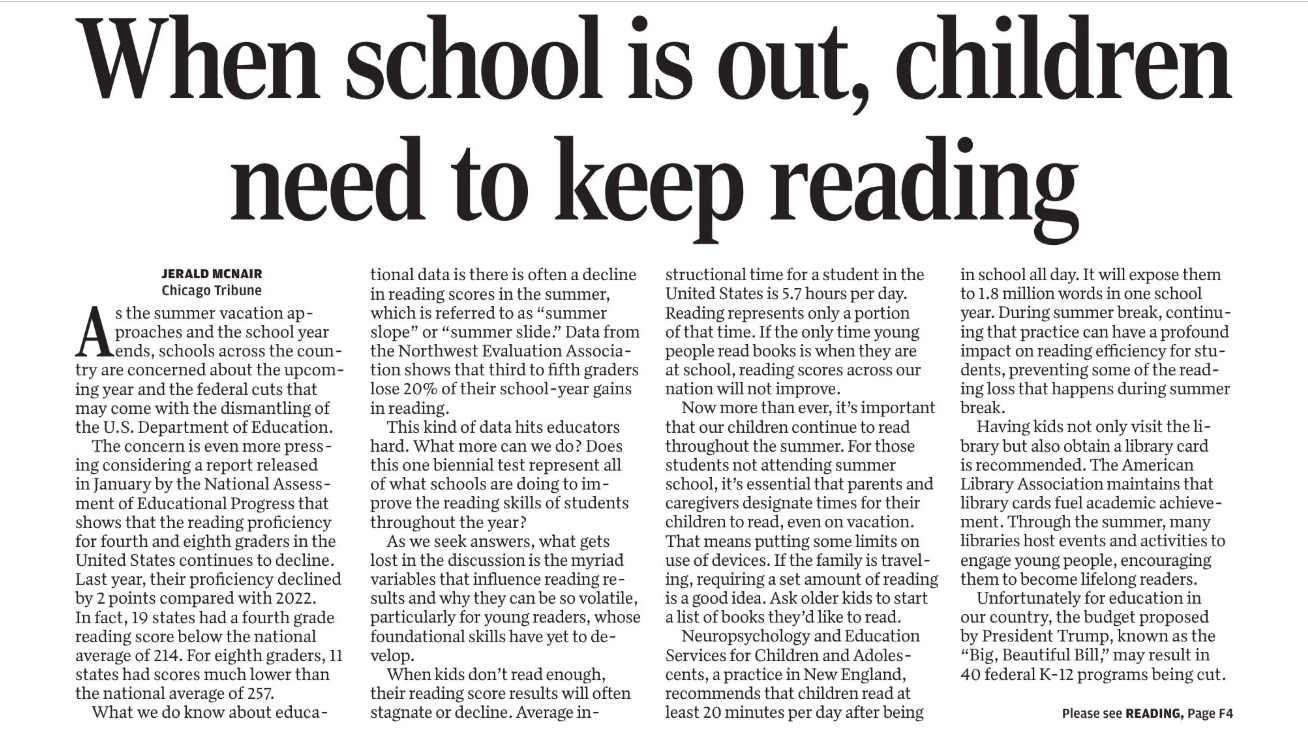
Jerald McNair’s recent op-ed in the Chicago Tribune—which appeared in today’s Buffalo News—delivers the data plainly. Reading scores for 4th and 8th graders continue to drop. “Summer slide”—the loss of reading progress over break—can erase 20% or more of what was learned. And once that momentum is gone, it’s rarely recovered. The Harvard Graduate School of Education even notes that after the first year of loss, little to no gain follows in the years that come.
So what do we do? We reframe reading as a cultural value, not just a school requirement.
I’ll be candid—I didn’t fall in love with reading until I was 34 years old. Better late than never. But once it clicked, it transformed how I viewed the world.
My friend Kevin Quinn, a lifelong reader with a degree in the classics, remembers his dad coming home from work in the 1970s and saying, “You’ve got two choices—go outside and play, or go read a book.” Growing up in Buffalo, Kevin chose books—especially when the cold kept him indoors.
For my own son, summer reading lists were the norm at his Jesuit high school. He’d spend most of the summer outside, living in the moment, but when August hit, he’d hunker down for a week of binge-reading to finish the list. It wasn’t always polished—but it built a muscle. And today, he still reads.
Now I see my grandkids—members of Generation Alpha—growing up fully immersed in digital devices. They’re bright, curious, and full of energy. But they need guidance to guard their attention spans. We try to encourage books alongside play, and we gently limit iPad time. It’s not about banning technology—it’s about giving reading a fighting chance to remain part of their rhythm.
And influence runs in both directions. My son now has the chance to shape the habits of his nephew—my 9-year-old grandson—who, like many kids his age, is a little too into PlayStation. Sometimes, the best messages don’t come from a parent—they come from an uncle, a cousin, or a grandparent. Maybe all it takes is a simple challenge: “Read for as long as you play.”
We could take a page from Malcolm Gladwell, who once wrote about how the American Cancer Society didn’t just raise awareness through commercials—they sparked a movement through community conversations. Hair salons were a key part of that success. Imagine if we took that same approach to reading. One real conversation. One bedtime story. One Kindle subscription. One nudge from a family member. It might just be enough.
If you’re still wondering why this matters, I point you to Garfinkle’s powerful whitepaper, The Erosion of Deep Literacy. It’s not just that fewer people read—it’s that we’re losing the ability to think deeply, empathize meaningfully, and analyze critically.
In a world addicted to quick takes and TikTok loops, reading remains our most underrated rebellion.
So this summer, forget flashy campaigns. Just ask your kids—or your grandkids—what they’re reading. And if they’re not, you’ve got a few choices: hand them a ball, set limits on PlayStation, or better yet—set a goal: read for as long as you play.
I can still vividly recall the magic moment when I learned to read in the first grade. It was transformative—right up there with learning to swim or the thrill of riding a bike for the first time. It felt like unlocking a new world of possibilities. Yet, for much of my early years, reading didn’t take center stage. The only books I remember from grade school and high school were assignments like A Tale of Two Cities, which left little impression. To get by, I often relied on Monarch Notes. My early reading repertoire consisted mainly of sports biographies: For some reason the two I remember are a story about Bobby Chandler of the Buffalo Bills and another about Jerry Kramer’s Instant Replay: The Green Bay Diary of Jerry Kramer.” Co-written with sportswriter Dick Schaap, an account of his near-death experiences and life as a Green Bay Packer. Beyond those, reading didn’t play a significant role in my life—until my early thirties.
Everything Changed at Age 34 At 34, my perspective on reading shifted entirely. My business partner walked into my office with a eclectic stack of ten books as I navigated a one-year non-compete clause after leaving my job. With time to consider and grow, I turned to those books and found my world expanding. The first book I picked up was Harvey Mackay’s Swim with the Sharks Without Being Eaten Alive. I remember reading it during one of my daughter’s gymnastics meets, making notes on Mackay’s famed McKay 66 customer insights, and sharing them with my father, the consummate salesman.
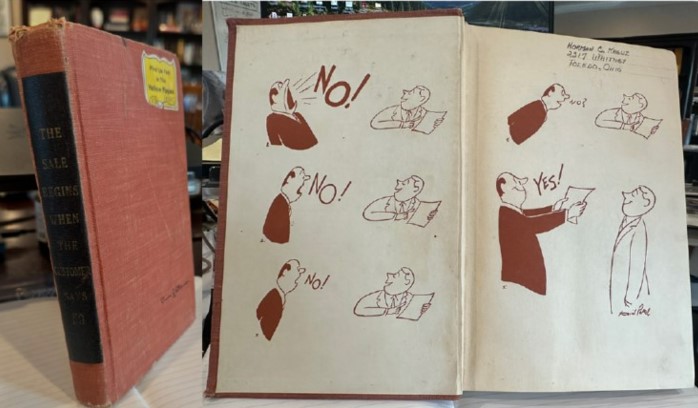
My dad then showed me the book he read, The Sale Begins When the Customer Says No, published in November 1953. The copy he shared, filled with humor and practical wisdom, offered a fascinating look at the sales principles he embraced in his career. This classic predates Harvey Mackay’s work and made me wonder if Mackay had drawn inspiration from it. Seeing the connection between these works reinforced the timeless nature of great ideas and their ability to shape generations.
That stack of books became a gateway to a new mindset. Titles like Seven Habits of Highly Effective People, In Search of Excellence, Swoosh: The Story of Nike and the Men Who Played There, and Herman Hesse’s Siddhartha inspired me to think deeper and apply their lessons to my life. That year helped me develop a habit of reflective, deep reading—equating insights from books to real-life scenarios. It truly was a new experience and my new walkabout was afoot.
A New Era of Reading Reading soon became a daily joy. Early mornings and airplane rides emerged as my favorite times to immerse myself in a book. A dozen or so friends of aspire to those peaceful, productive hours noted in my post on “The Early Risers Club.” I often reflect on how difficult it was to find quiet reading spaces during my high school years in a bustling household. Back then, the University at Buffalo Law Library became my haven for focused studying, even if it wasn’t traditional reading. Those moments honed my ability to concentrate and find value in written words.
Books That Stay, Books That Wait As I scan the shelves in my home, office, and Kindle history, I reminisce about the eclectic mix. Some books are unforgettable—like Ayn Rand’s Atlas Shrugged, a favorite that shaped my philosophical outlook and inspired its own dedicated article. It’s the only book I’ve ever read twice. After finishing it, I devoured The Fountainhead and watched the classic Gary Cooper adaptation. James Bradley’s The Imperial Cruise, Flags of Our Fathers, and The China Mirage, as well as Lawrence Wright’s The Looming Tower, were equally compelling, providing deep insights into historical and cultural contexts.
I also polished off McCullough’s John Adams and Harry Truman. McCullough’s depth of storytelling about generations past made me feel like I’d just completed a master’s class in U.S. history and almost finished with McCullough’s book about the Brooklyn Bridge. For that, I highly recommend all three books.
Some books, yet, stay unfinished. Titan: The Life of John D. Rockefeller, Sr. has eluded completion for five years, despite its fascinating content. I would’ve finished King Rat but I was channel surfing and came across the older movie version and that spoiled the rest of the mystery. Others, like A Man Called Intrepid, came into my life with a story of their own. A business partner’s unexpected departure prompted a friend to say, “The ones who stay are the intrepid souls.” That statement resonated deeply, compelling me to pick up the book. Then there are books like Rebel Ride that sit patiently on my shelf, waiting for their moment. I’ve often heard excerpts about Stonewall Jackson and wondered how the Civil War have unfolded had he not died in action.
The Erosion of Deep Literacy Adam Garfinkle’s article The Erosion of Deep Literacy helped me articulate the unique impact reading has on me. He defines deep literacy as the ability to engage with a text, anticipate the author’s direction, and connect it with personal knowledge to gain original insights. I often find myself doing just that—connecting characters and themes to real-life friends, colleagues, or situations. The article is worthy of a read for you deep thinkers so click here
Garfinkle also highlights how multitasking and screen use erode attention spans. While I occasionally pause my reading to research something sparked by a book, I’ve learned to embrace those moments as part of my curiosity-driven process. Still, I value the focused attention that deep reading requires, and I strive to cultivate it daily. My favorite digression is my Kindle’s access to a dictionary and Wikipedia.
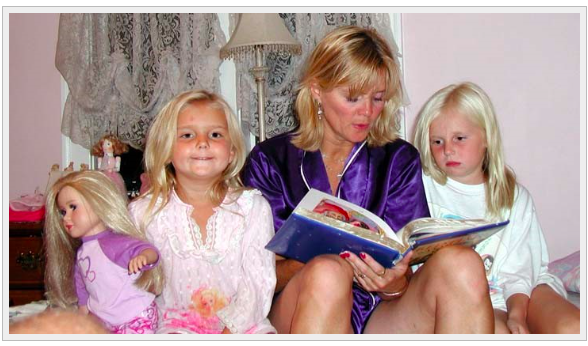
Reading and Family Garfinkle’s assertion that shared reading builds a foundation for literacy resonates with me deeply. Cindy and I always read to our kids. Green Eggs and Ham was so frequently read to Kelly that she memorized it. One night, when I skipped ten pages while half-asleep, she immediately called me out. Today, our youngest would rather read a book than watch TV—a testament to the impact of those early reading sessions.
My mother-in-law, Gisela, is another source of inspiration. A devout reader, she once told me, “A good book is a great companion.” Her thirst for literature reminds me of historical figures like John Adams and Thomas Jefferson, who clamored for knowledge. Gisela’s love for reading has enriched my own appreciation for books as companions in life’s journey. If one of my books goes missing, I usually know where to find it.
Why I Keep Reading Books offer reflection, knowledge, and the joy of escaping into another world. Whether it’s Atlas Shrugged challenging my philosophy, Brooklyn Brifdge story on The Great Bridge drawing parallels between the Brooklyn Bridge and building a business, or Garfinkle’s insights about literacy, reading always teaches me something new. It’s a lens through which I understand the world and my place in it.
My library has also become a touchstone for connection. Office visitors often comment on the eclectic mix of books, sparking conversations that transcend the original context of their visit. It’s a reminder that books don’t just shape the individual—they also create opportunities for shared growth and understanding. I had the privilege of observing screenwriter Tom Fontana’s massive library, a collection I still talk about to this day.
Final Thoughts Reading has been a lifelong journey of discovery, from the first-grade magic of learning to read to the transformative moment at 34 that changed everything. Books are more than words on a page; they’re threads that weave together knowledge, relationships, and personal growth. Each one carries a story—how it came into my life, how it influenced my thinking, or how it waits patiently for its turn. Through them, I’ve learned that every story, like every life, holds lessons worth discovering. There’s always room for a constant companion—that being a good book.
So, when you’re done with Jake from State Farm and his late-night, “What are you wearing, Jake?” commercials, and you’re still basking in the peaceful solitude of an early morning, why not pick up that book you’ve been meaning to finish? Who knows, it can just offer more wisdom than any ad for affordable insurance.

 josephkreuz.com