Human Connection Making a Comeback

Featured

What’s most enjoyable about life is that, on a daily basis, there are opportunities to meet new people. Human connection is at the heart of what makes life meaningful.

Yet we now live in an era where artificial intelligence is advancing at a pace few could have predicted. Photos are enhanced, voicemails generated, emails auto-written—entire video chats can now be convincingly faked. You can’t always trust your eyes—or your ears. So what do we trust?

What we’ve always trusted: the power of real, human relationships.

People have spent entire careers building, protecting, and nurturing relationships. Traders, artisans, the Fuller Brush salesman, the Avon Lady, the milkman, the local catalog rep—they brought more than products. They brought presence, personality, and trust. Whether it was a vacuum cleaner demonstration in the living room, a catalog left at the kitchen table, or a familiar face behind a longtime Elmwood Avenue storefront, these interactions were built on familiarity and connection. That legacy of human interaction is back at center stage. The handshake still matters. A face-to-face still wins the room. A coffee chat, a raised eyebrow, an offhand comment—all of those tiny, unprogrammed moments build rapport in ways no machine can replicate.

AI might be getting better at sounding human. But it’s still not being human.

AI-generated content—especially video and audio—will soon be so realistic, we won’t be able to tell what’s real and what’s fake. We’re on the brink of a new era of false perception and digital deception. For those who remember, Milli Vanilli was the Grammy-winning duo exposed for lip-syncing the songs that made them famous. When the truth came out, their careers collapsed.

In that spirit, an old advertising slogan feels more relevant than ever: Is it live, or is it Memorex?

That question is now front and center. Is what you’re seeing real—or just programmed to feel real?

There’s no question that AI has its place. It can process data, sketch ideas, and help refine language. But a tool is not a substitute for the talent—or the truth—behind it. What makes writing powerful, and work meaningful, is the human experience at its core.

We’re just a few years removed from the pandemic, when the world retreated into screens and home offices. For many, loneliness, mental fatigue, and isolation left lasting scars. In this post-COVID era, something powerful is reemerging: a hunger for authentic, in-person connection.

It’s showing up in meetings, networking events, and even casual run-ins at the grocery store. People want to reconnect—not just via a screen, but face to face. They want to see your smile, shake your hand, hear your voice. As trust in digital reality fades, trust in real relationships grows stronger.

This shift is also reshaping the workplace. Not long ago, many believed remote everything was the future. But now? Companies are calling people back—not just for productivity, but for connection. Culture doesn’t live in Slack messages. Loyalty isn’t built on Zoom. On Zoom, you can wear a tie and gym shorts; in real life, you wear the whole suit. Mentorship doesn’t happen in emoji reactions. Human presence matters.

Young professionals—those just starting out—are learning that what you know is important, but who you know—and how you treat them—matters just as much. Every relationship opens a door. Every meaningful connection leads to more. And the beauty of that principle? It never goes out of style.

No robot will ever replicate the nuance of a first impression or the feeling of being seen. No one walks away from a great meeting saying, “Wow, that Zoom background really moved me.” But plenty walk away thinking, “That person just gets it.”

As we enter an age of digital doubt—where even voices and videos may be faked—something simple is becoming rare again: authenticity. Cybercrime is rising fast, and trust is being exploited in new ways. Don’t hit “send” on that wire transfer until you’re certain the voice, face, or email on the other end is who they say they are.

That’s why the relationship economy is entering a renaissance. People will increasingly place value on realness. They’ll hire for it. Vote with it. Partner because of it.

If you’re fortunate enough to have strong relationships in your life, tend to them. And if you’ve been hiding behind screens or texts, show up. Shake hands. Ask questions. Listen closely. Connect deeply.

And the next time a perfectly polished message or AI-generated voice crosses your screen, ask yourself:Is it live—or is it Memorex?
If it’s real, you’ll know.

When You Need Me You Need Me

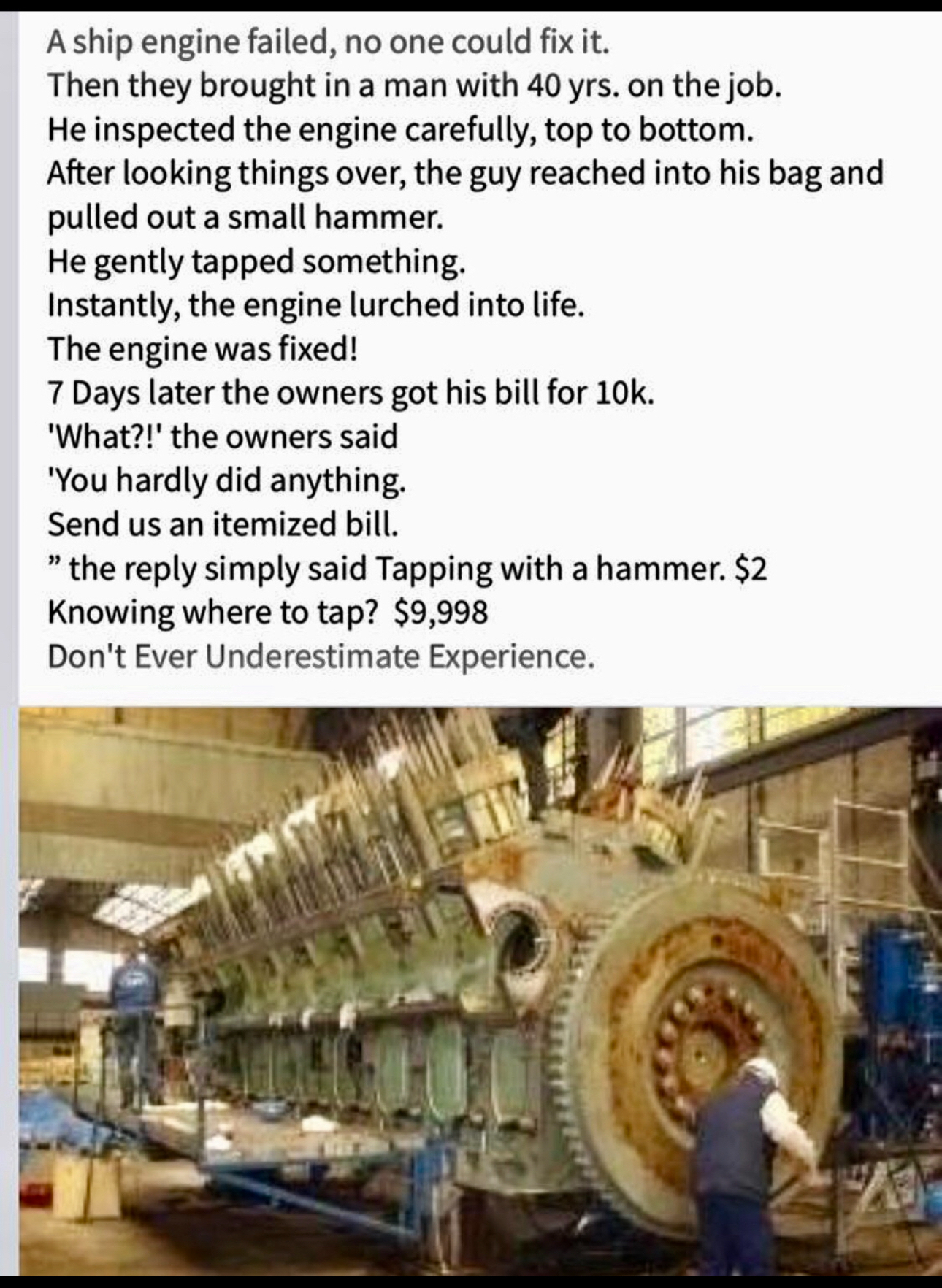
I’ve been circulating a cartoon for years highlighting the value of anyone paid a fee for services rendered. And just recently I read an article about an expert who fits the cartoon. Together, the cartoon and the article inspired these thoughts and this perspective. There are moments in every profession when clients realize, “When you need me, you need me.” It’s that simple. Sometimes, you need a specific solution, or things just go wrong. When they do, people look for that one person who brings years of experience, a steady hand, and the knowledge to make things right. I’m often reminded of this through three favorite examples: the cartoon featuring an engine repair expert who knew “where to tap,” the story shared by Froma Harrop about her plumber husband, and a personal experience from my friend Ron Papa, third-generation CEO of National Fire Adjusters. Ron and I are always on call. These examples perfectly capture why, in so many fields, people reach out to trusted experts, knowing they’ll get things back on track.

Take Froma Harrop’s story of her husband, a master plumber. When something breaks in the house, her friends and neighbors reach out to him—not just because he’s skilled, but as she writes, because they know he’s “the guy” who can fix it with precision and honesty. Similarly, the ship repair expert doesn’t charge for the act of tapping but for knowing exactly where to tap—a knowledge earned over years. These stories remind us that expertise is more than just visible effort; it’s about the understanding and intuition that only come with experience.

Then there’s Ron Papa, whose perspective adds a layer of commitment to this idea. As he says, “For seven decades now, since my grandfather started NFA, we chase disasters and offer solutions in times of catastrophe and duress. I keep a suitcase in my trunk and am available 24/7/365.” In fields like his, being ready to respond in moments of crisis defines the value of a true expert.

In many professions, clients often ask, “Why should I pay for this?” or “Can’t I do it myself?” But when the stakes are high, timing is critical, or the problem needs a quick and reliable fix, that’s when clients turn to professionals who deliver not just a solution, but peace of mind. Paying for knowledge—for knowing where to tap—is worth every penny when you’re in a bind.

It’s worth noting that many experienced professionals balance their work with goodwill and don’t always charge for every service. They understand that sometimes a favor today leads to future opportunities, and not every call needs to end with a bill. But when a fee is appropriate, it’s an investment in peace of mind and expertise—whether it’s a donation to your local fire department for the reassurance that they’re there when you need them, or paying an engine repair expert for knowing precisely where to tap. The fire department donation, modest as it may be, can be viewed as a fee—a proactive investment in readiness—while the engine tap fee is a classic example of paying for expertise.

Here are a few reasons why clients seek out these experts:

  • When They’re in a Bind: Sometimes, clients have urgent needs, whether due to an unexpected issue or a tight deadline. I often compare this to the fire department passing around a donation boot. You don’t need them every day, but when you do, you need them urgently. “You don’t need me now,” they seem to say, “but when you need me, you need me.”
  • For Access to Solutions Beyond Their Reach: Experts bring years of cultivated relationships, specialized tools, and industry know-how, which allow them to tackle issues that would otherwise seem insurmountable. Their network and expertise make them invaluable when unique challenges arise.
  • To Gain a Trusted Advisor: Part of the value an expert brings is their knack for listening and asking the right questions, helping clients understand deeper issues. It’s often about more than just the immediate task; it’s about offering insights into character, integrity, and values that help shape a better outcome.

So, when I say, “When you need me, you need me,” it’s about being more than just a problem-solver. It’s about delivering confidence, trust, and, let’s face it, a bit of humor when things go sideways. After all, even the most seasoned professionals know that sometimes, the real value is in making the hard stuff look easy. So the next time you find yourself in a bind, don’t hesitate to reach out. Just remember, you may be paying for that little tap—but it’s a tap you’ll be glad you didn’t try yourself!

A donation in this instance is a fee and pays when you need these experts.