Immigration to America ~ 1895 Peter Kreuz
As we commemorate December 7th, which holds a significant place in WW2 history, I also take a moment to reflect on the remarkable journey of the Kreuz family. This journey commenced in 1895, during Grover Cleveland’s presidency, when Peter Kreuz and his two brothers made the bold decision to immigrate from Bliesen, Germany, to Toledo, Ohio. Their pursuit was driven by a vision of fertile soil, idyllic summers, and ample farming prospects in Toledo. While the exact motivations behind their journey remain shrouded in mystery, we are deeply appreciative of the path they chose to undertake. My uncles tell me the Kreuz’s ran out of land in Germany as the family grew. It is still a mystery why the three brothers chose Toledo, Ohio. 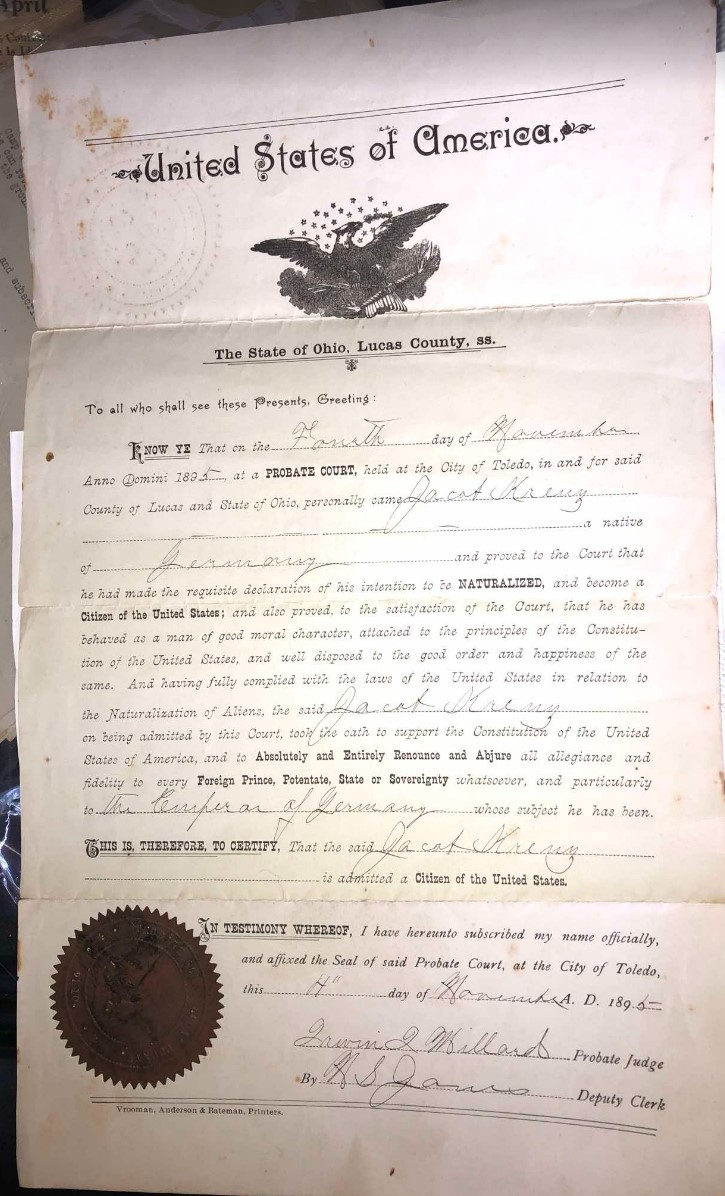
Generation 2 in America
The Kreuz family were stoic and hardworking farmers. My grandparents, Jacob Kreuz, my dad’s dad, and Lester Okuley, my mom’s dad, continued the family’s legacy.
The Kreuz side ~ my dad’s dad, Jacob, and his brother Wendel married sisters, Melvina and Jeannie Langenderfer. Together, they owned almost 200 acres of adjacent farmland in Swanton, Ohio. Jacob and Melvina had eleven children, while Wendel and Jeannie had seven. As a result, the Kreuz family name was well-known in Swanton. My dad was the seventh of 11 hard working children.

Twenty years ago, these Kreuz families held several reunions where they took over the entire Maumee Bay resort. Jacob and Wendel were great farmers, and Jacob’s detailed ledgers of equipment and seed costs, labor hours, and price sheets on grain, corn, strawberries, eggs, and milk are still kept by his daughter.

The family was self-sufficient, with the exception of sugar and clothes. Jacob had a greenhouse, a milk house, a hen house, a well, and a hay loft where they even played basketball on the second floor’s hardwood floor.

Jacob Kreuz’s farm covered 100 acres, and although he had considered purchasing another 100 acres of land across the road, he never did. In 1956, a hailstorm destroyed his greenhouse on the day of his grandson Dan’s baptism, leading to a less-than-ideal return from the church ceremony. However, Jacob’s fruit and vegetable growing operation continued to thrive.

The Kreuz farm including greenhouse, dairy cattle, chicken coupe, milk house, grain loft, equipment and tool barn and living quarters.
During their high school years, from 1942 to 1945, my father and his older brother, Bob, played an essential role on the family farm. Their daily routine involved hours spent picking tomatoes, followed by the task of loading the produce truck to its absolute capacity. They would then embark on an 80-mile journey to Detroit’s market, strategically timing their trip to coincide with favorable tomato prices and a Detroit Tigers baseball game. Arriving at the market, they would refuel their truck, catch the game, sleep in the truck overnight, and rise at 4 AM to sell their produce. By 5 AM, they were back on the road, returning home to milk the cows by 7 AM. Their unwavering commitment to the farm was evident, and a decade later, my cousin Jerry, now 85, vividly recalls their adventurous endeavors, which also involved the participation of his nephew, Jerry Parks, the son of Burt Parks and Aggie Kreuz-Parks.

Here is the link to the farm my mom grew up on. Lester and Mildred Collins-Okuley farm
My mother, Mary Elosie Okuley also grew up on a farm. The Kreuz and Okuley families were known for their remarkable farming skills and hardworking ethics.
My grandma Mildred Collins-Okuley’s (my mom’s mom) family owned a farm that was 45 minutes away from Jacob’s by car. Mildred’s father, DA Collins, was the first President of Hamler State Bank founded in 1921. My mom is still a shareholder today in Hamler Bank, a testament to the lasting legacy of these hardworking farmers.
My mom’s grandpa Frank Okuley, was a great man who owned five farms, one for himself and one for each of his sons including my grandpa Lester. On our visits back to the farms from Cleveland, we spent ample time at both farms, and we knew the route oh too well as we made the trek from the Kreuz to Okuley farms. Riding four in the front and four in the back, my dad drove like a banshee to and from the farms during our visits.
However, when great grandpa Frank had a debilitating stroke and died, his son Albert, who was greedy and jealous, bought the better farm owned by my grandpa Lester, causing a complicated land swap. In short order, Lester had the best farm in the region again, and he was known for his exceptional farming skills that even his brother Albert couldn’t deny.
My parents, Norman Kreuz and Mary Eloise Okuley Kreuz, were also farmers with parallel paths. Mom told me that Lester was the best farmer of his three other brothers, which is why he was so successful, even during the Great Depression. Not so lucky were many other farmers in Ohio and the Midwest who had to abandon their farms.
In 1953, my mom introduced Norman into the house the day the farm swap happened, bringing him home for the first time shortly after her parents had moved into the swap house. As my mom put it, “it wasn’t such a bad deal as my dad got the big brick home that he grew up in.” It was only a matter of time until Lester turned the farm into what he lost to Albert in the swap, and it was right around the time when grandpa Okuley bought his first Buick, a trophy for his success.

My mom didn’t dislike too many people in her life, but her brother-in-law Albert made the list as a result of his dirty pool play. Come to find out the details. Lester’s dad Peter had a debilitating stroke and the four brother’s farms needed to be realigned. Great Grandpa Peter had 5 sisters and one went on to watch over and be his caretaker for another 30 years.
My mom is a deep thinker still full of wisdom and historical knowledge. Her mind remains crisp at age 92. She reads my updates and helps fill in the blanks. Mom never had a driver’s license. She recalls their farmhouse being electrified in 1937, plumbing and running water while she was finishing #1 in her class in nursing school in 1952, and then there was grandpa’s great big Buick he bought in 1954.

Parallel stories with great leaders from the past
When I think about the Kreuz/Okuley stories, I can’t help but draw parallels to two remarkable individuals from our history, John Adams and Harry S. Truman. What’s fascinating is that, like the Kreuz and Okuley families, Adams and Truman started their journeys as farmers before taking on the monumental task of leading our nation.
Picture this: after the tumultuous years of World War I, Harry S. Truman made a life-changing decision. He left his job at the bank behind and joined forces with his father to create something special—a farming partnership known as J.A. Truman and Sons. It was a bold move that reflected his deep connection to the land and his determination to make a difference in the world.
Harry S. Truman later would write in his diary. “You know as long as a country is one of that kind, people are more independent and make better citizens. When it is made up of factories and large cities it soon becomes depressed and makes classes among people. Every farmer thinks he’s as good as the President or perhaps a little bit better.” McCullough, David 19T23:58:59). Truman. Simon & Schuster.

The Truman family farm in Missouri
Even though Truman wrote that about farmers, he left the farm for WW1 in 1930 where his sister did what she had to do and ran the day-to-day farm. The war ended; Truman threw in the towel upon returning from France to become a retailer. The farm equipment was sold, and the land leased and the next chapter began for him.
Truman and my uncle Al Kreuz had similar career paths. Truman became a judge and county commissioner, much like my uncle. Uncle Al started out as a farmer, served in the military, and eventually owned a prosperous Texaco station after the war. Al later owned a popular Ohio Turnpike restaurant and became a politician, serving as Fulton County Commissioner. Uncle Al won his first election but lost re-election, prompting him to run again four years later and regain the seat.
Truman and my mother shared a love for reading and playing the piano, but I never learned how to play. Truman once got himself in trouble while showing off his piano skills to Lauren Bacall at the White House.

My grandmother, Melvina Kreuz, had a total of 14 children over the course of 27 years. All of her children were born on the family farm, but unfortunately, three of them died at birth. My dad told me that after giving birth, Melvina was back in the fields two days later, supervising and directing traffic with my grandfather, Jacob. I remember seeing a daily log kept by both of my grandparents with meticulous notes over the years, including information about hired hands in addition to their own children, as well as grain and corn prices.
In May 1945, something remarkable happened in my family. At just 17 years old, my father made a life-altering decision—he enlisted in the Navy. It was a choice filled with determination and patriotism, but it wasn’t without its challenges.
You see, the year before, my uncle Bob had attempted to enlist but was denied. The reason? To keep my grandfather’s farm running smoothly. Grandpa Jacob was fiercely devoted to the land and the family’s livelihood. He felt that Uncle Bob was as vital to the farm as any soldier was to the war effort.
I’ll never forget the day Grandpa Jake, known for his strict demeanor, stormed into the enlistment office to argue his case. It was a display of passion and commitment that left a lasting impression on all of us. Whenever my siblings and I visited the farm, we knew to be on our best behavior, respecting the legacy of our family and the deep-rooted values that connected us to the land.
The military played a significant role in my family’s history, not just for my dad, but for his younger brothers as well. Al and Jerry, my dad’s siblings, both answered the call of duty.
Al, after the war, took on the role of an Army peacekeeper, contributing to the post-war effort to bring stability to the world. Meanwhile, Jerry’s service came during the Korean War, where he faced the challenges of that era.
And it wasn’t just the men in our family who served with honor. My Aunt Aggie Kreuz also made her mark in the military. She served in the Navy, entrusted with the important task of handling sensitive secret documents for none other than FDR’s chief, Clifford Clifford. It’s a legacy of service that we are incredibly proud of and one that underscores the deep commitment to our country that runs in our family’s veins.


The challenges that modern-day farmers face are similar to those of the past. Today’s farmers struggle with the economic impacts of COVID-19 (which was Smallpox back then) and the current turmoil in supply lines for products they need to run their businesses. They also face uncertainties related to staffing shortages (which were resolved in the past by having more children who could work on the farm), market-set prices for their crops or animals, and the unpredictable nature of the weather.
My dad was always rather reticent when it came to discussing his experiences during World War II, whether it was before, during, or after his service. It wasn’t until years after he had passed away that I stumbled upon a profound revelation.
One day, while chatting with my mom about the recent launch of the USS Littlerock from the Buffalo harbor, I couldn’t help but express how much I wished my dad, Norm, could have been there to witness it. To my surprise, my mom reached for a handwritten letter and an accompanying photograph. These treasures had been carefully preserved, and they contained my dad’s heartfelt words.
The letter, penned by my dad aboard the USS Hank in 1946, was addressed to his mother, Melvina. As I read its contents, I finally gained a glimpse into the innermost thoughts and emotions of a soldier, shedding light on a part of his life he had chosen to keep private for so long. It was a poignant moment that allowed me to connect with my father’s past in a way I had never imagined.
When President Truman assumed office following Roosevelt’s passing, my mom was a mere 14 years old. Yet, even at that tender age, she held a profound admiration for him, deeming him one of the greatest presidents in her lifetime and a true savior of millions of lives.
While Truman shouldered the immense responsibilities of leading the nation, my dad was stationed aboard the USS Hank, somewhere in the vast expanse of the Atlantic Ocean. Truman’s role as Commander in Chief extended over an armed forces comprising over 16 million dedicated men and women. Additionally, he commanded the largest naval armada in history, a formidable fleet boasting 10 battleships, 27 aircraft carriers, and 45 cruisers, along with an unprecedented arsenal of planes, tanks, guns, financial resources, and cutting-edge technology.
As history teetered on the precipice of its most harrowing chapter, prior to the fateful deployment of the two atomic bombs, the Chiefs of Staff calculated that the conflict in Europe might endure for another six grueling months, while the Pacific theater could potentially drag on for an additional year and a half. Truman’s leadership during this pivotal moment would ultimately shape the course of history, bringing an end to the most devastating war the world had ever witnessed.
Similarly to Truman after WWI and my dad and his brothers after WWII, the wars ended, and life moved on. Truman opened up his haberdashery, and my dad went to the University of Detroit. Norman, on the other hand, dropped out of college during his sophomore year after receiving a call from his roommate, Jim Ryan, to play in a golf tournament at Arbor Hills Country Club. Norm dropped his pitchfork, took Grandpa Jake’s car for two days without permission, and upon returning, lived with his sister MaryJane after he got kicked out. Eventually, they rekindled, dad left college, got a job with the Yellow Pages, and retired forty years later. As for my mom and most girls during the war, they either went to college or started raising families. Eloise chose nursing school, where she met my dad at a VFW post dance, and they were married four months later in September 1953. Tim was born a year later, and Mom returned to nursing when baby brother Butch was old enough to be left alone.
Fourth generation exposure to the farm
When I was just six months old, my family packed up and moved to Cleveland, prompted by my dad’s job offer at Ohio Bell. It was a significant change for us, considering our roots were deeply intertwined with the farm life. Surprisingly, all 14 of my aunts and uncles, despite their upbringing in the rural setting, shared a unanimous sentiment: “Once high school ended, none of us wanted to be farmers.”
Even my godmother, Aunt Regina Kreuz, went to great lengths to escape the farm’s clutches. She enrolled at the University of Alabama, a decision fueled by her desire to break free from the agrarian lifestyle, engage with a broader social circle than her 27 cousins and ten siblings, and perhaps find a husband.
Yet, amidst this collective resolve to seek different paths, there was one exception – my mother’s younger brother, Ed Okuley. Ed possessed an unwavering love for farming, a passion that set him apart. Tragically, at the tender age of 13, Ed’s life was cut short in a devastating tractor accident. He was the sole family member who had eagerly embraced the prospect of taking over the family farm. His untimely loss cast a heavy shadow over our family, and my mom attended his funeral before embarking on her own career journey as a nurse, although it turned out to be shorter than expected.
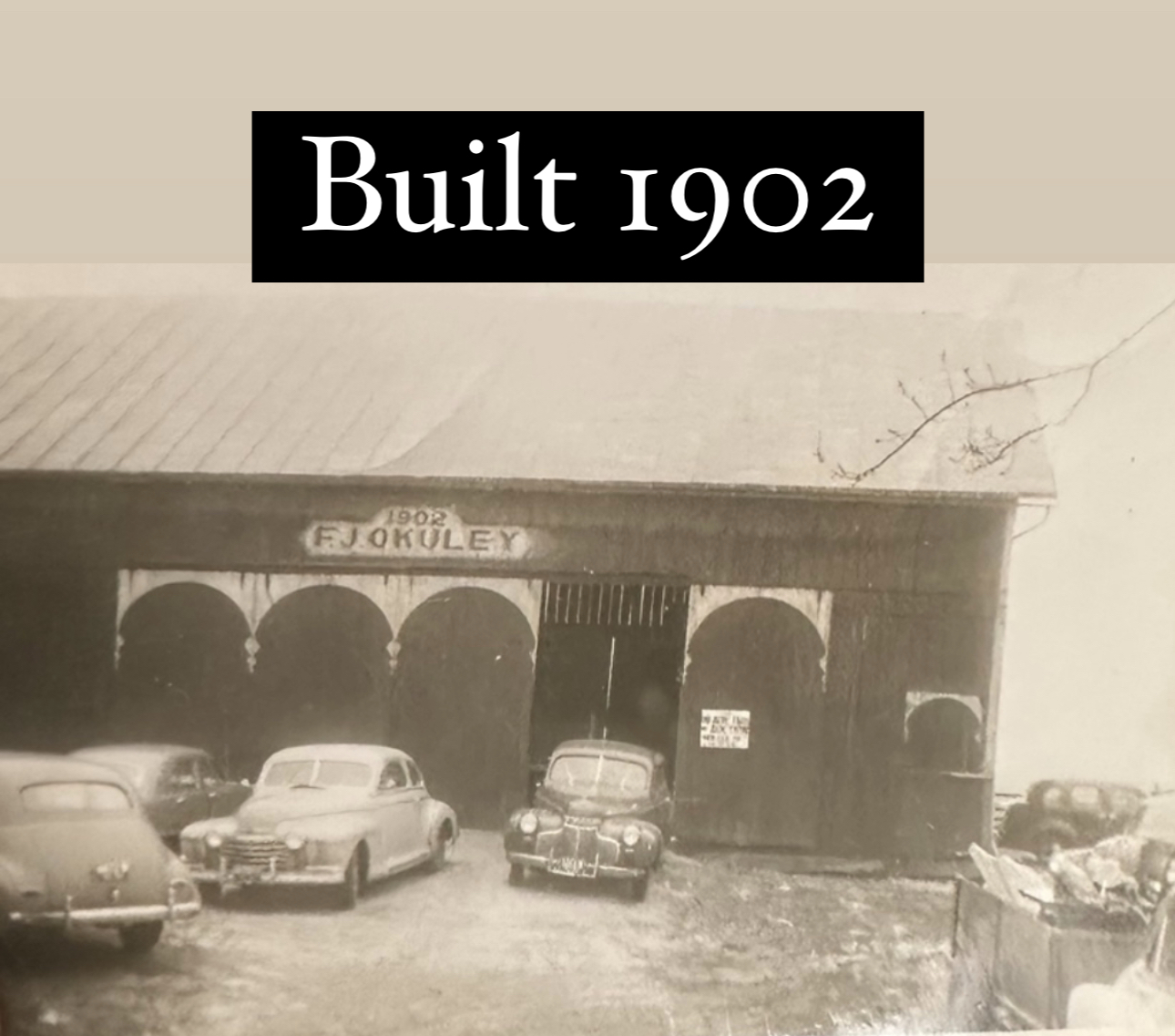
Growing up, my siblings and I spent our childhood on the farms, visiting four times a year from our home in Cleveland and later Buffalo. We learned the tricks and trades of farming, and those trips, chores, and skills came in handy later in life when Cindy bought me a 1956 Ford 600 tractor with York rake to groom our property.
Our days on the farm were nothing short of an adventure. We lent a hand when needed, but we also managed to squeeze in our fair share of mischief. Whether it was unintentionally terrorizing the animals, taking aim at the rain gauge with our playful antics, or accidentally breaking a few things, there was never a dull moment.
Nonetheless, our time on the farm allowed us to gain a firsthand appreciation for the upbringing that Norm and Eloise had experienced. We got our hands dirty, quite literally, as we learned the ropes of farm life, from the rhythmic act of milking cows to the arduous task of plowing fields. We scoured the chicken coop, baled hay, wielded hoes in the fields, rode alongside in the combine, and even perched atop the hay wagon for a unique perspective.
Living the farm life was an eye-opening experience, especially the early mornings that began promptly at 5 AM and the constant, unrelenting work that occupied us 24/7, 365 days a year. It was a world that taught us the true meaning of hard work and dedication.
.
On a parallel path to my parents’ story is that of my mother-in-law, Gisela Serrer-Driscoll, whom we know today as Oma. Gisela was born in Oberndorf, in the community of Rottweil, Germany in 1932. During her youth years, her father mysteriously disappeared, and his whereabouts and lineage remain a mystery. By 1945, when Gisela was 13 years old, her German town was destroyed by Allied bombers, and she, like many others, had to endure the terrors of post-war.
Despite being a young teenager, Gisela witnessed the constant concern of disease, lack of food, ruined housing, and an entire population of good German citizens displaced and walking aimlessly about the countryside. There were no men around; they were either dead, escaped, or prisoners of war. We don’t often talk about it, although she sometimes drops hints about what life was like during those times. Once, when the kids were watching “Saving Private Ryan,” she walked into the room and said, “Please turn the television off. If you lived what my family lived through, you’d never watch that kind of show ever again.”
During the war, Gisela’s mother remarried, and she gained a loving stepfather and two more siblings.
In the early 1950s, Gisela became a nurse, and it was during her time at the hospital that she met a dapper post-war Army soldier, Sargent William Driscoll, who swept her off her feet. She came to America with him, but tragically, William passed away, leaving Gisela as a German immigrant working as a nurse at the VA and raising her children on her own.
In present times, Gisela has a boyfriend named Frederick, who is fluent in German and originally from Poland. Frederick was only seven years old when the Germans invaded Poland in 1939, and although he doesn’t speak much about it, we occasionally get glimpses into his life during that time.
April 8, 2023 ~ we will be celebrating the passing of uncle Jerry, the last of 11.
As Winston Churchill once said, “It is not even the beginning of the end. But it is, perhaps, the end of the beginning.” This sentiment rings true for the Kreuz family as well. While we say goodbye to this generation, it is only the beginning of a new chapter in our family’s story.
Let us honor the lives of these 11 children by carrying on their legacy, by living with kindness and compassion, and by striving to create a world where all children are loved, protected, and empowered to reach their full potential. Together, we can build a brighter future, one that would make our departed loved ones proud.

At my sister Ann’s wedding, this family came from all four corners of the country and someone was smart enough to have then align in descending order.
~ ~ ~ ~ ~ ~ ~ ~ ~ ~ ~ ~ ~ ~ ~ ~ ~ ~ ~ ~ ~ ~ ~ ~ ~ ~ ~ ~ ~ ~ ~ ~ ~ ~ ~ ~ ~ ~ ~ ~ ~ ~ ~ ~
My brother Terry shared some tidbits with me a while ago and it’s worth adding a few captions and sayings from my grandparents, parents and aunts and uncles.
- A bumble bee is considerably faster than a John Deere tractor.
- Words that soak into your ears are whispered… not yelled.
- Life is simpler when you plow around the stump.
- Meanness doesn’t just happen overnight.
- Forgive your enemies; it messes up their heads.
- Do not corner something that you know is meaner than you.
- It doesn’t take a very big person to carry a grudge.
- You cannot unsay a cruel word.
- Every path has a few puddles.
- When you wallow with pigs, expect to get dirty.
- The best sermons are lived, not preached.
- Most of the stuff people worry about, ain’t never gonna happen anyway.
- Don’t judge folks by their relatives.
- Remember that silence is sometimes the best answer.
- Live a good and honorable life, then when you get older and think back, you’ll enjoy it a second time.
- Don’t interfere with something that ain’t bothering you none.
- Timing has a lot to do with the outcome of a rain dance.
- If you find yourself in a hole, the first thing to do is stop digging’.
- Sometimes you get, and sometimes you get got.
- The biggest troublemaker you’ll probably ever have to deal with watches you from the mirror every morning’.
- Good judgment comes from experience and a lotta that comes from bad judgment.
- Lettin’ the cat outta the bag is a whole lot easier than putting’ it back in.
- If you get to thinking’ you’re a person of some influence, try ordering’ somebody else’s dog around.
- Live simply, love generously, care deeply, speak kindly, and enjoy the ride.
- Don’t pick a fight with an old man. If he is too old to fight, he’ll just shoot you!
- Your fences need to be horse-high, pig-tight and bull-strong.
- Keep skunks and bankers at a distance.

My dad, US Navy, 1946 aboard the US Hank.

 josephkreuz.com
I so enjoyed reading this article. I am Wendell’s daughter, Eileen and in my late 80,s. My parents had seven children not six. And our farm was adjacent to Jakes . I worked on uncle Jakes farm during strawberry season As well as trimming tomato plants, picking tomatoes for market and loading them on the truck.. Bob would often let me drive the tractor while they were loading. I think I was nine or ten years old then. Those were the good old days. However, I didn’t think so at the time. Keep writing.
Hi Eileen. Please call me at 716.445.2210 or send me your number and I will call you. Your brother Jim and my dad Norman were very close and I so enjoyed talking to him about my dad, and also his rockstar granddaughter Gabriella Kreuz
You sure had an interesting family I never knew you were a farmer haha Bob was in the navy also I never knew your mom was a nurse very interesting reading soooooo many kids wow on a 1 to 10 scale I give you a 10 for your writing skills love sherry
Joe… I thoroughly enjoyed your family’s history. What an incredible family you have. Thank you for sharing!!!!
Lynn Halicki
Thank you for reading
Joe,
Great writings
Just had the best therapy, spending the morning writing how my life has been impacted by being a Kreuz kid.. OMG please let me know if possible WordPress has anything sent from me , egad
I think I now have WordPress ability
Will post again
Thanks Larry
Got it bro. Write an article and I’ll add it to my blog as an excerpt